Category: Disability

  • Today we were reminded how much knowledge and consideration of accessibility is needed in society. Ironically after an Access Matters Aotearoa event. The below description highlights the need for change in the Accessibility for New Zealanders Bill that is at the select committee as we speak.

    Today, I attended a work-related event in the city. Again it is a cold and rainy Friday night at dusk with a third weekend in a row of red weather warnings after flooding across the North Island and raining consistently.

    My Guide Dog Sienna and I had a ride from the venue to the Civic, where our bus goes from. The timetable showed two cancelled buses after the current one, so we must catch that particular bus. As our bus pulled up, we walked to the front door as usual and waited for the driver to open it.
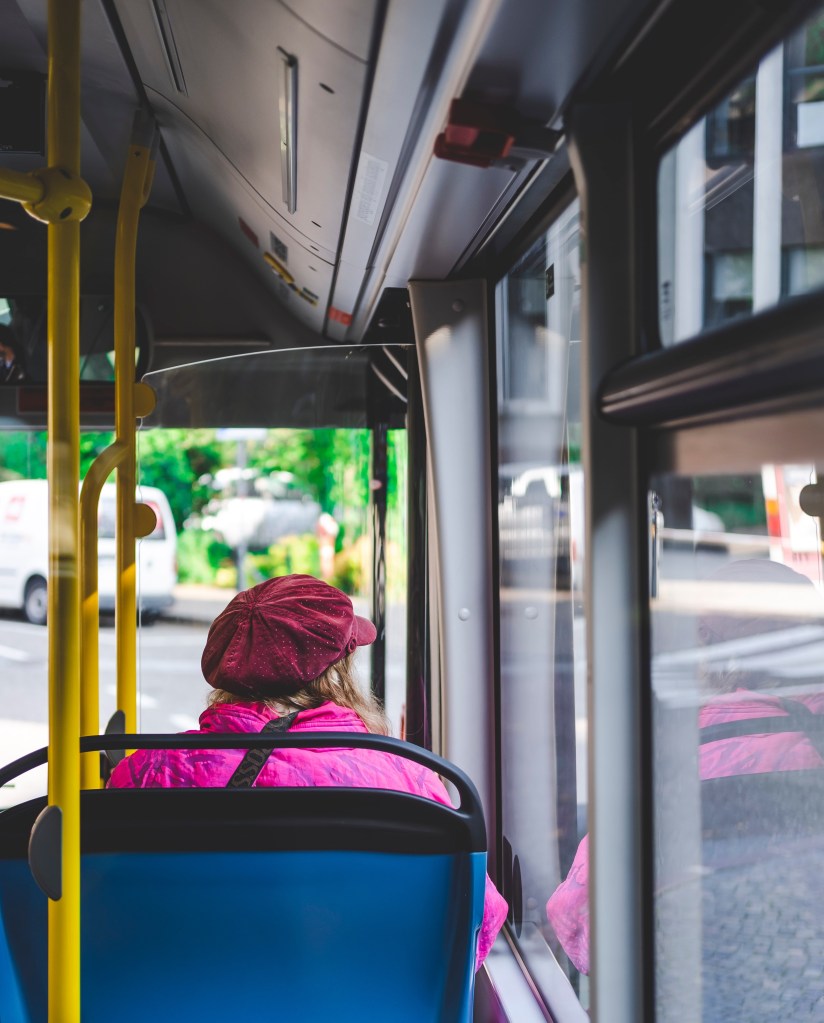
    Woman wearing pink sitting on a bus - view from behind.
    Woman sitting on a bus

    And waited … and the door still didn’t open. We stood there in the rain, and several minutes later and after knocking on the door, a passenger got off the bus and said that the driver was pointing for you to use the back door. I have some residual vision, but it wasn’t good enough to see the driver through the door to see his hand signals.

    We got on the bus and the driver didn’t utter a single a word. We made our way to accessible seats so that there was enough room for us both.

    Later, an elderly man pushed the button to get off. The driver stopped and opened the back door. We heard his walking stick got the floor as he dropped it trying to manoeuvre around seats and others from accessible seats to the back door. He struggled gripping seats and in a weak voice said “thank you driver” and tentatively stepped off. There was still not a word or movement from the driver and I noticed the bus didn’t kneel for this passenger who struggled to step down from the bus.

    The bus continued and when it was our stop the driver only opened the back door. We stood and Guide Dog Sienna started to lead me to front door as she is trained to do. The driver said nothing, did not open the door or even turn around. I corrected Guide Dog Sienna and we moved to the back door getting off. It was raining incredibly hard at this time and the step down from the back door was steep as the bus was not kneeled.

    There would have been a few things that could have helped in this situation. From a General and accessibility point of view. First the driver could have communicated.

    I never found out why the front door was not opened. It did not appear broken and no one said. However, getting a replacement bus with a front door that opened if it was in fact broken, kneeling the bus for passengers to get on or off, or any sort of communication with passengers would have helped this situation.

    This experience made me consider several things, firstly older adults have disabilities and access needs that are often overlooked or considered aging not something that can be mitigated in similar ways.

    Secondly communication is key and many of the adaptations that provide those with a disability access can also assist others who may not have access needs. For example in this case communication.

    This situation also highlighted the need for accessibility legislation with clear, measurable and regulated guidelines would make access needs more visible and widely accepted in society.

    ,
  • A woman covering her face with a book.

    I am an articulate, well-educated person who practices self and systems advocacy regularly. These days I rarely encounter problems I cannot find a workaround to mitigate. However, the below example illustrates the extra effort that a disability can bring to something as simple as purchasing a textbook and the often hidden time and effort those with disabilities use to find solutions.

    To improve my article writing, I enrolled in a 12-week course that relies heavily on a textbook and the activities within that textbook. With today’s technology, such as Amazon Kindle and Audible, I thought obtaining an electronic textbook could be more straightforward. The course is framed around working through the 12 chapters of the book and meeting weekly with a group of colleagues after completing reading and associated writing tasks.

    As I write this, we are in week four of the course and as someone who is blind, I am finding it difficult to engage as the course materials are not available in a format that is easily accessible. I want to caveat this with the Information that this situation is not due to a lack of time or self-advocacy but systems.

    I enrolled in November and was asked if I wanted the textbook and asked for an electronic textbook version which I was informed was available. Other participants were supplied with print copies. However, it wasn’t available in New Zealand and required contacting international Organisations. When I found out it was too close to Christmas, many places had shut down for the break.

    On my return to work, I asked the library if they could source me an electronic version, As I had no luck purchasing one. When they couldn’t, I approached the Blind And low Vision New Zealand (BLVNZ) Library, which had no copies.

    As the course Start date got closer, I tried more overseas sources; I pay for an Audible and Bookshare subscription which is US-based and supplies audio or e-book formats. I thought I had a good chance of getting the book from either of these. The common roadblock has been that it isn’t available in New Zealand. However, I had no success. I lived in the UK For a while and still have access to RNIB library electronic and audiobooks, so I searched these databases with no luck.

    By this time, the course had begun, so I ordered a print copy from Amazon, thinking I would make do. I soon discovered that on top of a full-time job and visually heavy daily tasks, reading a chapter a week and doing the associated coursework wasn’t feasible when it was in printed text.

    Some might suggest using a magnifying glass. This is a legitimate workaround; however, this takes time and causes slow reading with visual fatigue. Doing this extra visual work involves using my remaining vision and means I am faced with deciding whether self-improvement or saving my vision for work tasks is more important. Seeing my colleagues achieve Work and self-improvement concurrently can sometimes make me feel a sense of failure as someone who thrives on improving myself and the world around me; continually rationing what I can achieve after experiencing not having to ration my vision can be disheartening.

    Four weeks into the course, I have been contacted by an organisation that can record the book if I can send my print copy But the catch is there is a three-week time frame Meaning we would be at week six before I put fully engage with the same access to the resource that others have had since December.

    What I have learned is that there are services that can assist. However, these are not necessarily well-advertised or well-known. Furthermore, the lead times mean that in time-dependent situations, access to publishes electronic copies of things like this may be more beneficial.

    In the meantime, I have sourced another print copy of the book and with this, I can continue until the audio version is ready. What I’m grappling with is that by the time I get the audio version, we will be six weeks into the 12-week course. Is it worth my time and extra energy to use the print book or to save my vision for other related work tasks that need my attention? In other words, is the effort and fatigue worth it when I am already three weeks behind and using resources that are not fit for purpose?

    The example has illustrated the extra effort that having a disability brings to everyday tasks like picking up a book and reading it or, in this case, sourcing a book that others can quickly obtain.

    Reflecting on the situation has made me realise just how much extra and hidden effort it takes for someone with a disability to achieve personal improvement and everyday tasks like purchasing a book. Similarly, it shows how often I need to actively compare the amount of visual fatigue that a task will cause with what I will gain from from competing it. In this case, I will likely opt out of a professional development activity so that I can function to continue doing my day job.

    On some levels this feels like a failure, yet on another level it can be seen as self care. Regardless of the feelings, the above situation illustrates a very commonsituation for those of us who live with disability. This is that to access our society requires more effort, workarounds and adaptations particularly when access needs are not always considered at inception or design.

    , ,
  • This week I was reminded just how changeable my vision is in a day. I will tell a story to illustrate.

    One of the catchphrases in the blind community is that blindness is a spectrum, which is accurate. What is usually even more unexpected is the changeability in that spectrum on any one day. I had sometimes forget myself.

    Earlier this week, I walked with my Guide Dog, Sienna, into our staff room at work. I saw two people about a metre, maybe two away, that I didn’t recognise but wanted to sit next to them. I couldn’t hear them talking as there was chatter from people behind me. I approached the sofa with my coffee and asked, “do you mind if I sit here, you aren’t afraid of dogs?”

    There was silence. No one answered. I am even unsure if they heard me speak. Someone behind me said Sally sit down they are OK.

    What I then realised a few minutes later was that the people on the sofa were colleagues I had known for many years and considered friends. Earlier I had spoken to someone else in that spot and identified others at the same distance perfectly.

    This reminded me of the many influencing factors to how I recognise people. Firstly it is primarily by their voice. Suppose that isn’t possible, several other factors, height, hair colour, clothing style and colour are available. On further reflection, I do ask people “is that …” if they walk by fast talking and I am unable to see them.

    In this instance, one of my colleagues was wearing her hair up, which she rarely does at work and wearing a clothing colour and style I had never seen her wear before. The other colleague I hadn’t seen for a while and had a haircut.

    I was also reminded just how changeable my vision is over a day and consider the pathophysiology that causes this. I have normal tension glaucoma and need an eye pressure below 16 mmHg to slow optic nerve death and a pressure of at least 7 mmhg for my eye to maintain its shape (there are other conditions and considerations which make this higher than the usual 5 or 6 mmhg for others. During any one day, my pressure is between 4 and 14 mmHg. Lately, I have noticed more variability and have symptoms of pressure below optimum far more often than not. The pressure is a delicate balance and any treatment to raise my pressure runs the risk of causing more harm than good in the long term.

    The most noticeable symptom is blurred and distorted vision that changes with the pressure over a day. It means that my prescription glasses may be perfect one moment and make my vision worse later. As a result, I think I keep my bank balance near zero and my optician in business. The variability has become too frequent to warrant continually changing glasses.

    Many believe blindness means total blindness or is consistent for all people all the time. I had forgotten the extent of the changeability and impact this had until I didn’t recognise my friends in the staff room.

    What I have noticed since I got Guide Dog Sienna 9 months ago is that this is a trigger for most of the occupational therapy staff with offices near me to state who it is when they approach, for which I am becoming more and more grateful as time goes on. Often it is “hi sally it is …” The next step in this journey is for me to become more accepting of this need and comfortable to ask people who they are without feeling I am interrupting them or being a burden.

    The other timely reminder for me is that constantly changing vision over a day causes such as increased cognitive load and fatigue. With this in mind, my lesson is to be more forgiving and less hard on myself if I am not able to continue with vision-heavy tasks at that time and those around me can continue or I can’t finish things in the same timeframe as my colleagues.

    I hope what I have shared here can assist others in some way.