Category: Disability

  • Recently I completed an interview on accessible places in Auckland for Stuff, which led me to reflect on the messaging around access needs and the normalisation of poor access encouraged in our society.

    When asked what places in Auckland had good accessibility, I found this difficult to answer. Firstly I thought, what does good accessibility look like and then how do I explain the complexity and nuances involved?

    So often, I see one size fits all solutions being implemented in many contexts. While in some situations, these may make a difference for some, they may not. This approach also promotes a societal perception of a singular solution and singular experience of disability and access needs.

    Suppose I relate this to my disabilities, which are blindness and hearing impairment. With both of these, there is often a societal perception of have or have not. You are blind or are not, which again promotes a singular problem and solution.

    As an example, if I am working with my Guide Dog Sienna, the majority of the time I am in the community, people will either assume I have no vision or am fully sighted and am training her. I was standing outside the Art Gallery in Auckland yesterday talking with someone and I was approached by one tourist and their friend who wanted to photograph my Guide Dog. They asked me if I was training Sienna, and I replied, as I usually do, “no, she is my guide dog”. The tourist promptly said, “but you don’t look blind”.

    My initial thought was to answer, “what does a blind person look like”? But in my experience, sarcasm isn’t a good educational tool. So I let them take a photo and explained that many forms of blindness manifest differently and individuals’ experience of these is also unique instead of focussing on “the look” of someone who is blind.

    With this in mind, in the interview, I expressed the role that people play in making a place “accessible” and that making a place accessible is multifaceted and doesn’t always relate to physical access needs alone.

    My experience of the UK and some of Europe in 2019 was that access needs were more normalised and a part of everyday life at most tourist attractions. While in many cities, the physical access needs were less developed than in some of NZ, it was the forethought, staff attitude and availability of things like audio description, touch tours longer timeframes for those with access needs that made a big difference. In the place I went, there was more of a willingness to individualise experiences, for example, asking “how can I best help”, “would you kike some assistance”, “here is what we offer” and so on. In the UK, on multiple occasions, I was offered a large print menu automatically.

    Sally standing in an exhibition with a guide a dog Sienna sitting next to her.
    Accessible Audio Described tour at Auckland Art Gallery.

    In NZ, people will make assumptions I can not read a menu. They may be right in some situations, while in others, I can read a menu. There are so many contextual influencing factors like the size of the print, the contrast and layout of the menu, how visually fatigued I am and the environment’s lighting. Many times I will walk up to the counter in a cafe and ask what flavours of drink they have, only to have the person behind the counter say they are written over there, point at a board on the wall that I can not see and their body language or demeanour will show that answering that question is an inconvenience.

    Often my answer is would you mind telling me as I can’t read them, or pulling my phone out and taking a photo of where they are pointing to zoom in and try to read this. Often the time taken in doing this is considered a further inconvenience by some staff, exacerbating their original issue and negative perception of disability.

    There are multifaceted solutions here that include addressing physical access needs and ensuring an inclusive and positive environment. Another example, just yesterday, before my interview, was entering a cafe for a drink. I asked about flavours and then asked if the counter staff could point me in the direction of a free table as the cafe was very busy, all the tables I had seen on my way past weee full and there were a lot of moving people. First I got “over there” without hand gestures, so I assumed they were using their eyes to indicate this. I said excuse me, what direction is that and she answered, “outside”

    One solution I particularly liked overseas was restaurants and bars that have a table number in large print and Braille with an app to order. As a blind person navigating crowds to a counter to order is challenging, I gravitated to this option when available as the menus etc., were already accessible.

    Those who know me well will know I like good local coffee but dislike Starbucks for many reasons. However, despite what I consider to be better coffee elsewhere, I find myself ordering from Starbucks at times because they have app-based ordering and payment options.

    In response to the need for social change, I developed a website celebrating good access experiences in NZ (http://www.shoutoutforaccess.com). However, as a time-poor academic, I am struggling to keep the momentum of this social change initiative and the financial commitments of the domain name and hosting charges. If anyone would like to assist with maintenance or sponsor this site so that user logins and self-posting could be added, please reach out.

    Back to the overall theme of accessible tourism in Auckland. The question that keeps springing to mind is, “who’s responsibility is poor accessibility in society?” my answer to this would be everyone, with education leading to social change is the key component.
    , , ,
  • On the 1st of October, it will be six months since Guide Dog Sienna entered my life! To mark the occasion, I will write a series of posts over the next few weeks explaining the difference working with a guide dog has made for me.

    It seems like a lifetime ago that Guide Dog Sienna arrived at my house. In reality, it was 1 April 2022 and we promptly began our training the next day. At the end of the training, we were released into the world and that is where much of the learning began!

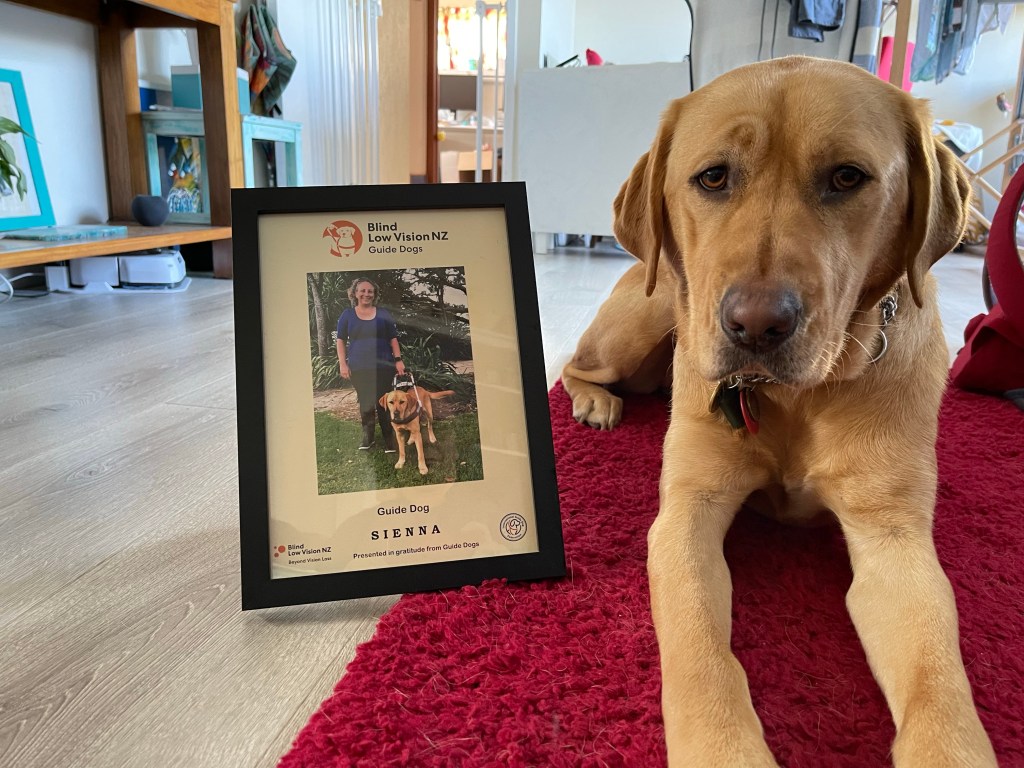
    Sienna a Golden Labrador cross sitting next to our geaduation photo.
    Sienna sitting next to our graduation photo – a gift when we graduated as a guide dog team.

    The most significant change I have noticed is that I am more confident when out and about in unfamiliar environments. Working with Sienna has considerably decreased the fatigue associated with navigating the environment with deteriorating vision.

    I will describe an example. I had not noticed that I had unconsciously stopped going out as much and was experiencing extreme fatigue due to vision changes and associated cognitive load with getting around my environment.

    One particular instance where this was particularly challenging was after I got a new hearing aid and had a professional event after work with a health informatics organisation I support (about a year ago) in a part of town I was unfamiliar with.

    I did my usual preparation with bus routes and arranged to call a friend to get me when I arrived at a local Pub as I was worried I would not be able to see her in a crowd so we could walk the rest of the way together. This journey meant walking through the city at dusk during rush hour. I had lost about 30 degrees of my central vision over the preceding six months and was pushing myself to keep engaging in my professional responsibilities.

    I was walking up Victoria St in Auckland, there was rush hour traffic, many people bustling and dreaded road works that made the route different to what I expected. The sun was going down and reflecting of a building making it very difficult to see anything. I was using my cane but because of the new hearing aid and vision loss the visual and audible stimulation this situation became overwhelming. So much so that I needed to stop, sit on a nearby bollard and close my eyes to recover a little.

    To give more context, I had about 20 degrees of vision on my left lateral side (now I have about 5-10 degrees). In this area, my vision is patchy and my brain fills in the gaps in vision that the blind spots obscure. When I am tired or in fast-moving crowds, my brain stops being able to fill in the gaps. This causes distortion, nausea and dizziness.

    After five or so minutes, I continued up the road to the Pub, texted my friend and I waited for around 10 minutes. I followed this up with a phone call which went to answer phone. By this time, the street was even more crowded, so I went into the pub to look for them. There were four large areas. I scouted around all of these, hoping that one of the groups would recognise me or I would recognise one of their voices.

    Unfortunately, I didn’t recognise anyone and no one called out. I went back outside where I had arranged to meet my friend and called again, getting her answer phone. By this time, the visual distortion from the crowd and traffic made me nauseous, dizzy. and emotionally drained. I was already tired from a typical work day, so I decided it would be best to go home and skip the awards dispute wanting to go. I left my friend a message saying I would get something to eat and head home because I couldn’t find the group.

    I retraced my steps, realising I would need to walk some distance to get the bus home, so I stopped at a small cafe to get a cup of tea. My friend called me as I finished my tea, saying her phone was in her bag and she got my message. We agreed she would wait outside the pub. I decided to join the group and returned to the Pub.

    With the fatigue associated with getting there, I found interacting with the group in a noisy social environment almost impossible and had run out of energy. In hindsight, this may have been an excellent opportunity to listen to my body and go home to rest.

    However, I chose to push on my goal had been to reengage with professional obligations, colleagues and industry. We walked as a group down to the company hosting the event.

    Awards were given, and food and drink were shared, but I was so exhausted I couldn’t engage at the level I usually would have. I was lucky my friend noticed and arranged a lift home for me with a colleague, as the travel to the event had left me physically and emotionally exhausted.

    I had applied for a guide dog about eight months before this occurred, thinking that it would be something that would be useful later in my life. I had heard that the wait time was 2-6 years and that getting a guide dog was something of the future. It was after this that I realised that perhaps working with a guide dog was something I needed at that time rather than in the future.

    If I contrast this with similar events now with Guide Dog Sienna, the difference is immense. Last week we went to Wellington to a Digital Health Leadership Summit, which was all city centre, unfamiliar routes and many people and moving objects. However, having Sienna there decreased my visual fatigue and cognitive load as she helped me avoid people and objects as opposed to locating and navigating them with a white cane and vision. This means I don’t need to use my remaining vision or interpret tactile feedback and is the difference between participating fully or in a limited fashion.

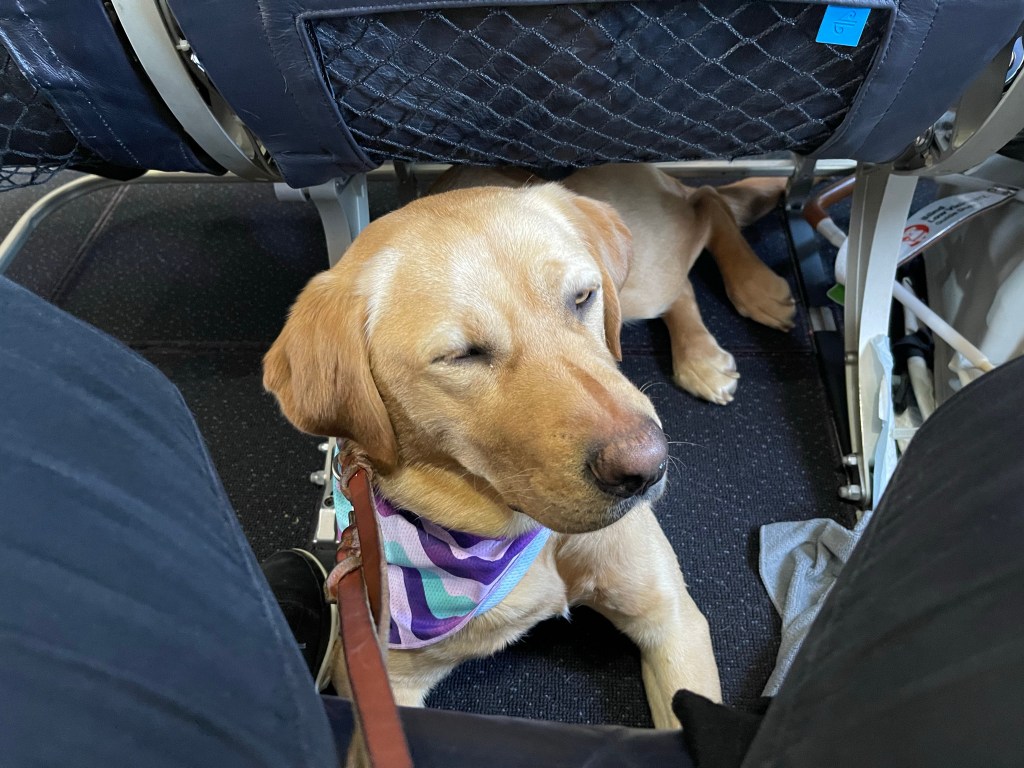
    Sienna curled up under the seat in front of me on the Plane on our way home from Wellington last week.

    While I didn’t attend one function, this wasn’t related to my vision or fatigue but redundancy notices at my work that I wanted some downtime to process that announcement.

    So the conclusion of my first post about the difference that Sienna has made is that she has allowed me to function with less cognitive load and visual fatigue in my job.

    I can’t end a blog post without some Sienna cuteness.

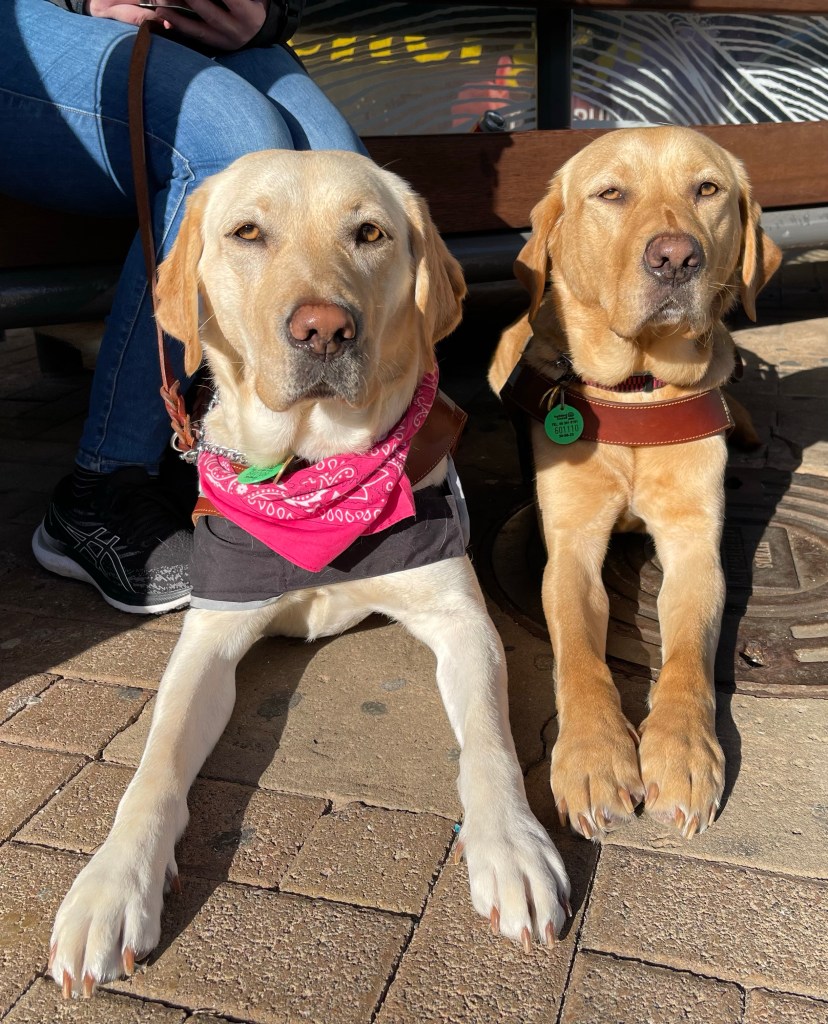
    Sasha left a golden labrador guide dog with Sienna right a dark golden labrador waiting at the bus stop together.  Both in harness in down position.
    Guide Dog Sienna with her Sister Guide Dog Sasha last weekend when we went out for dinner and a show.

  • When some of my acquaintances lose a pair of sunglasses, I hear the phrase, “I will just buy another cheap pair…”. I wish it was that easy and didn’t involve navigating a stereotype.

    Over a week ago, I misplaced (likely on the bus) my sunglasses. I did the usual things like phone the bus company and searched my home and office but came up empty-handed each time.

    Many reading this probably assume I could buy another pair of the same. I wish that was the case and will go on to explain.

    As my vision has decreased, using what I have remaining is extremely important from a safety and quality of life perspective. I have multiple eye conditions, each causing sensitivity to light and glare. Interestingly each condition requires a slightly different tint to provide optimal viewing and finding that perfect fitting and tinted pair of sunglasses is challenging.

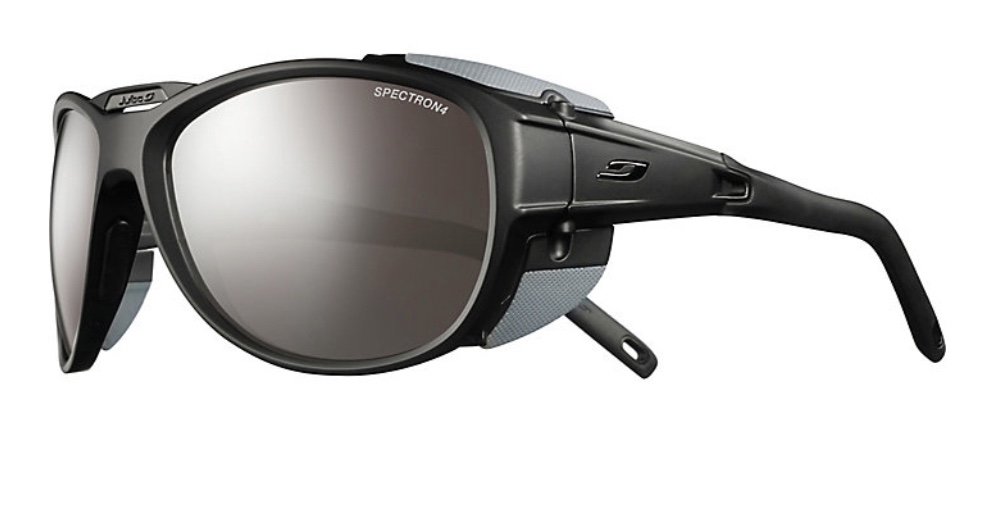
    My last pair were, in fact, the best I had found. These were the Julbo Explorer 2 High Mountain with dark brown (category 4) spectrum tint. A person recommended this particular model who has low vision and lives in the US. She explained this model decreased glare and the side shields blocked light from getting around the sunglasses.

    Although not the most becoming feature, the side shields worked very well. I have had multiple surgeries on my eye, which have altered the shape. I had an emergency iridotomy around 2009 that lets light into my eye through iridotomy, distorting what I see and putting q band of glare into my field of view. While this can not be repaired and occlusive contact lenses to stop this, our unsuccessful sunglasses with side shields made the difference between being able to function outdoors and not being able to.

    Julbo Explorer 2.0 with spectron high mountain lens
    Photo of the Julbo Explorer 2 with spectrum high mountain category 4 dark brown lens. Photo – https://www.moosejaw.com/product/julbo-explorer-2-0-sunglasses_10352650

    These sunglasses are designed for mountaineering and another particularly useful feature was the built-in venting to stop them streaming up.

    There are few places that stock this particular model of sunglasses in New Zealand and those that are out of stock at the time of writing this post.

    Did I mention the price – between $270 and $349 and sunglasses of a similar calibre and quality (but so not meet my needs) are around the same price or more.

    The part that bothers me about this stereotype is the helplessness people often associate with it, which feeds the negative or deficit construct of disability. I am an independent, strong and articulate person who would ask for help if required. However, for the most part, I adapt and problem solve to function without assistance (other than Guide Dog Sienna, that is) to navigate everyday life.

    In society, there is a stereotype of a blind person as needing assistance (helpless, potentially a burden on society etc.), totally blind, and wearing dark sunglasses with either a cane or a guide dog. I spend much of my life educating people to help them realise that most of the blind community does not match this. In that, blindness is a spectrum and is highly individual. Not everyone needs a cane, guide dog or sunglasses. As an example, I can function without these things. However, wearing sunglasses reduces pain and glare while using a cane or guide dog, keeps me safe and all reduces the visual fatigue from navigating and adapting to an environment that is designed for those with sight.

    I was surprised that the thought processes associated with a stereotype of a blind person held by some of our society have crept into my journey to buy new sunglasses. With this in mind, I would like to share my perception of my disability as a contrast.

    My disabilities do not define me; they are something I navigate to contribute successfully to society. Yes, navigating an environment built for those with good vision is difficult, fatiguing and frustrating at times, and often tasks that rely on vision take me longer to complete, but it doesn’t stop me from participating or contributing.

    However, living with a disability has also given me opportunities, such as an understanding and lived experience. Coupled with skills such as being a health care professional, educator, researcher and computer scientist allows me to provide multiple contexts while advocating for myself and others to improve our environment and societal perceptions of disability.

    Back to the sunglasses, if I could afford and somehow import the same model I had, I would. However, my investigations found this to be challenging in an adequate timeframe. As I am finding glare challenging without my sunglasses, I have spent most of the day in many suburbs across Auckland trying on different makes and models of sunglasses to find a pair that meets my needs.

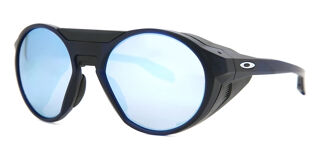
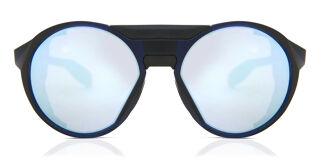
    Form and function are hard to match. The best lenses I could find were in a sport/cycling pair of sunglasses by Oakley, the Jawbreaker model, which would not have been suitable to wear to the office or formal functions. The more formal or traditional sunglasses did not provide the coverage required. The best model so far is the Oakley Clifton Deep Water sailing as they have removable side shields and excellent lenses – the downside is the cost of $379.

    Oakley Cliften Sunglasses picture from website listed in caption.
    Oakley Clifden Translucent Blue (Deep Water lens) – Photo – https://image4.cdnsbg.com/1/441/479693_1599508998135.jpg?width=320&height=160

    So the search for sunglasses continues and I am looking forward to finding the perfect pair.

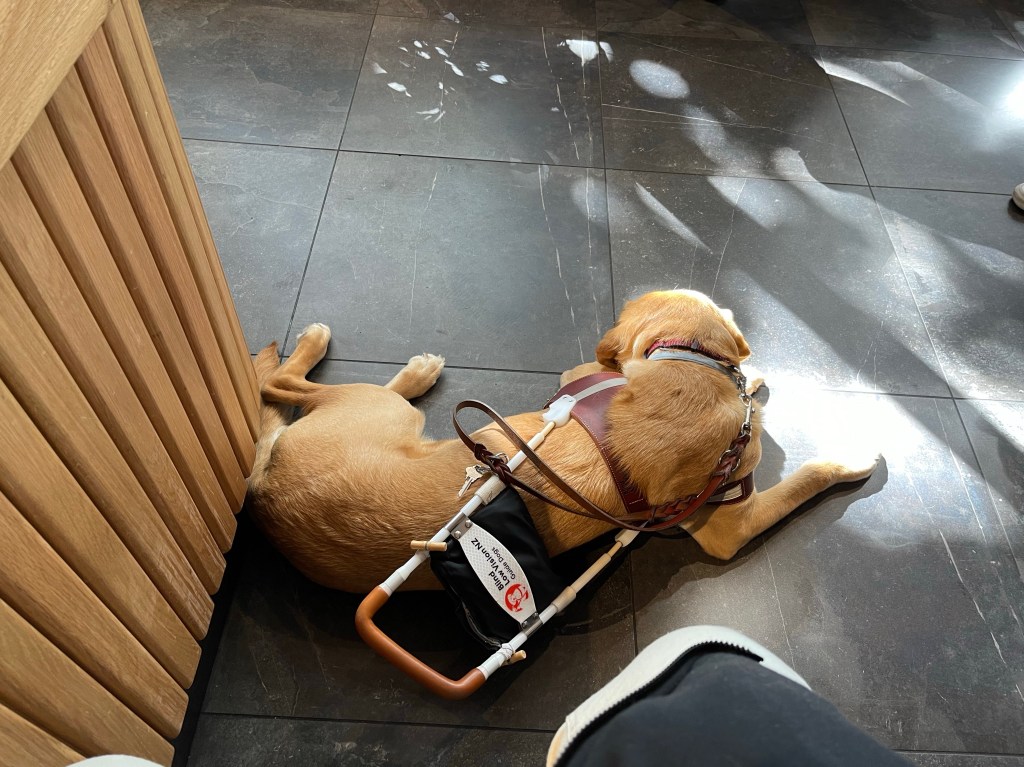
    A blog post would not be complete without a photo of Guide Dog Sienna, so below is a picture of her trying to lay in a tiny piece of the sun coming through a coffee shop window while we took a break from sunglasses shopping.

    Guide Dog Sienna in her harness laying in the sun.
    Sienna is enjoying the sun in a cafe today.
    , , , ,