Category: Education

  • This week I was reminded just how changeable my vision is in a day. I will tell a story to illustrate.

    One of the catchphrases in the blind community is that blindness is a spectrum, which is accurate. What is usually even more unexpected is the changeability in that spectrum on any one day. I had sometimes forget myself.

    Earlier this week, I walked with my Guide Dog, Sienna, into our staff room at work. I saw two people about a metre, maybe two away, that I didn’t recognise but wanted to sit next to them. I couldn’t hear them talking as there was chatter from people behind me. I approached the sofa with my coffee and asked, “do you mind if I sit here, you aren’t afraid of dogs?”

    There was silence. No one answered. I am even unsure if they heard me speak. Someone behind me said Sally sit down they are OK.

    What I then realised a few minutes later was that the people on the sofa were colleagues I had known for many years and considered friends. Earlier I had spoken to someone else in that spot and identified others at the same distance perfectly.

    This reminded me of the many influencing factors to how I recognise people. Firstly it is primarily by their voice. Suppose that isn’t possible, several other factors, height, hair colour, clothing style and colour are available. On further reflection, I do ask people “is that …” if they walk by fast talking and I am unable to see them.

    In this instance, one of my colleagues was wearing her hair up, which she rarely does at work and wearing a clothing colour and style I had never seen her wear before. The other colleague I hadn’t seen for a while and had a haircut.

    I was also reminded just how changeable my vision is over a day and consider the pathophysiology that causes this. I have normal tension glaucoma and need an eye pressure below 16 mmHg to slow optic nerve death and a pressure of at least 7 mmhg for my eye to maintain its shape (there are other conditions and considerations which make this higher than the usual 5 or 6 mmhg for others. During any one day, my pressure is between 4 and 14 mmHg. Lately, I have noticed more variability and have symptoms of pressure below optimum far more often than not. The pressure is a delicate balance and any treatment to raise my pressure runs the risk of causing more harm than good in the long term.

    The most noticeable symptom is blurred and distorted vision that changes with the pressure over a day. It means that my prescription glasses may be perfect one moment and make my vision worse later. As a result, I think I keep my bank balance near zero and my optician in business. The variability has become too frequent to warrant continually changing glasses.

    Many believe blindness means total blindness or is consistent for all people all the time. I had forgotten the extent of the changeability and impact this had until I didn’t recognise my friends in the staff room.

    What I have noticed since I got Guide Dog Sienna 9 months ago is that this is a trigger for most of the occupational therapy staff with offices near me to state who it is when they approach, for which I am becoming more and more grateful as time goes on. Often it is “hi sally it is …” The next step in this journey is for me to become more accepting of this need and comfortable to ask people who they are without feeling I am interrupting them or being a burden.

    The other timely reminder for me is that constantly changing vision over a day causes such as increased cognitive load and fatigue. With this in mind, my lesson is to be more forgiving and less hard on myself if I am not able to continue with vision-heavy tasks at that time and those around me can continue or I can’t finish things in the same timeframe as my colleagues.

    I hope what I have shared here can assist others in some way.
  • Today has been a long day that has caused me to reflect on the influence of disability on work-life balance and the societal expectations and the impact these have on our ability to achieve sustainably.

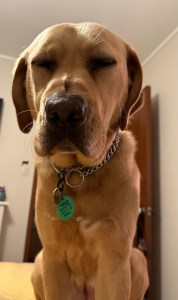
    I will give a background and a fur baby story to set the scene. I have been quite sick with atypical pneumonia, narrowly escaping a stay in the hospital with fast talking and daily check-ins as there was no care for my fur babies at home.

    Last night I finished my last meeting at 1930 and felt energised and ready to change the world, metaphorically speaking. I went to bed soon after as I knew I had to be at work by 0730 for an early international zoom meeting.

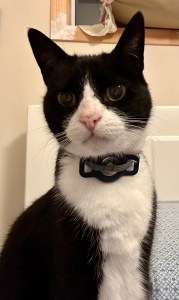
    This morning I was woken by the fur babies at 0430 because they were hungry. It started with a 15-year-old cat named Sylvester, who came and sat on my chest. When I woke, Guide Dog Sienna, who had just turned two, joined the circus, trying to get my attention. Last but not least is my younger cat Annie who found a toilet roll I had on the bed (as I still have the remnants of a cold) and decided to attack / shread this.

    As someone with rapidly progressing blindness, getting enough sleep and pacing visually fatiguing activities is an essential part of self-care. I recently came across some research explaining the effect cognitive load associated with low vision and was surprised at just how much effect this can have.

    I had experienced a similar realisation about cognitive load when moving from travelling a white cane to guide dog travel. Travelling using my vision and white cane relied on more cognitive load to process the environment as I needed to find and process objects. In contrast, a guide dog avoids objects, thus, decreasing cognitive load and visual fatigue. This can be compared with a chaotic and decision-dense paediatric resuscitation where the increased cognitive load can lead to potentially life-threatening errors. Some examples of literature around this are below.

    With this and other research in mind, cognitive load affects performance. Bringing the story back to the impact of vision loss on cognitive load.

    Today I needed to go through about 140+ assignments to make sure all instructions were followed / elements included as there were differences between markers and I needed to determine the extent of the problem before I could ask for any assistance. This a very vision-heavy process that would not be required if no disparity was found in moderation. This is probably only the second time I have needed to go through this many in 11 years.

    Adding in less common tasks like this adds visual processing and cognitive load. What I gave no thought to was the impact of this visual task on my day and week after needing to do this. I had already been told that there was no extra staff this week to help and knew that we were already behind in returning work as I had been very sick and unable to moderate. So I just got on with it; a process had served me well in the past when I had more vision. However, now with less vision, I need to be more aware of the consequences. To give context, I have a total of about 5% of the visual field of a person who has no field loss.

    The personal consequences of doing this are multifaceted and include eye pain, headache, fatigue, nausea and more which often continue for a day or two. One situation I noticed today was with two people at my office talking to me while I put on Sienna’s guide dog harness and a group of about 2-4 people approaching. I hesitated between removing Sienna’s lead and putting on the harness for enough time for her to escape and follow one of her favourite people. I can usually manage the visual processing of that many people if I am not already visually fatigued. The processing, headache and eye strain did not allow me to respond quickly at this point, causing chaos around my retrieval of said Guide Dog. It wasn’t until reflecting on this situation for future prevention that the fatigue and cognitive load components of this became apparent.

    The consequences of not looking over all the assignments are potentially increasing student distress and anxiety as well as answering many more emails asking how long until results are out of dispute announcements. One dilemma this raises is what is more important, the needs of one versus the needs of many. Do I want to prevent stress, anxiety and emails, or do I add them to my workload later?

    I easily forget that I can’t always approach things the way I traditionally have. For example, I throw more of my personal time at something or spend all day on it to make it happen when it causes a new set of problems or issues to resolve later. This raises blurred boundaries and expectations around what is acceptable when taking work home to complete it.

    Is there an expectation it will be finished despite the work time available? Who’s expectation is this, an employer or employee, workplace culture or societal view?

    With low vision in mind, one of my ways to mitigate decreasing vision has been taking work home to complete. However, the downside is increased fatigue and cognitive load, so a delicate balance is required. It would be interesting to find out how others feel about taking work home to complete as an accommodation to mitigate a disability. Why this seems acceptable in some situations and not others? Is this equitable?

    A similar concept is a trend in society to expect others to do more with less on a constant or continual basis in multiple aspects of our lives.

    A consistent message has been to do more with less on many fronts, for example, in healthcare, education and volunteering. In the past, phrases like keep calm and carry on, have been valued and, in turn, may have become an expectation rather than a mantra. One could argue that this concept could be applied to other situations as the output of an action is valued more than the vehicle to get the output. I question the sustainability and wonder if this mindset influences a culture of competition, blame and inadequacy for some.

    We need a social change in areas such as nursing or healthcare to value a person and their experience on a journey rather than measuring the outcome. Suppose we continue to be conditioned to value the outcomes above over the vehicle. By subscribing to this, are we creating an inclusive and equitable culture?

    From a personal lens, I wonder how much society has influenced me to value others over myself. Or in the case of student anxiety above my health or comfort? Similarly, with a progressive disability lens, does valuing the outcome without consideration of the journey allow an equitable situation?

    I hope sharing my thoughts has provoked some thought and conversation.

  • I hope others learn from the stories and reflections I share on this page. With this in mind, I would like to share a story from last week to illustrate how societal assumptions affect individuals and influence others.

    This started with a bus journey. On the way home from work, Guide Dog Sienna and I were going to get a bus as we needed to get home quickly.

    We waited at the shelter. At this stop, three routes are scheduled close together at certain times of the day (2 minutes apart). The sun was shining, so I shaded my eyes to give me the best chance to see the bus approach. Because of the traffic, it was hard to hear the difference between vehicles. As a bus came, I signalled to the driver to stop.

    The bus pulled past the bus stop; Sienna and I walked to the door and stepped in and asked the driver, “is this bus the XXX bus?”. I waited for an answer and he sat, not acknowledging me, staring forward. He didn’t answer or even acknowledge me. I took a step closer and said, “excuse me, is this the XXX bus?” He gestured upward and said, “You saw it”, to which I answered, “actually, I didn’t; I can see the bus shape but couldn’t see the number”.

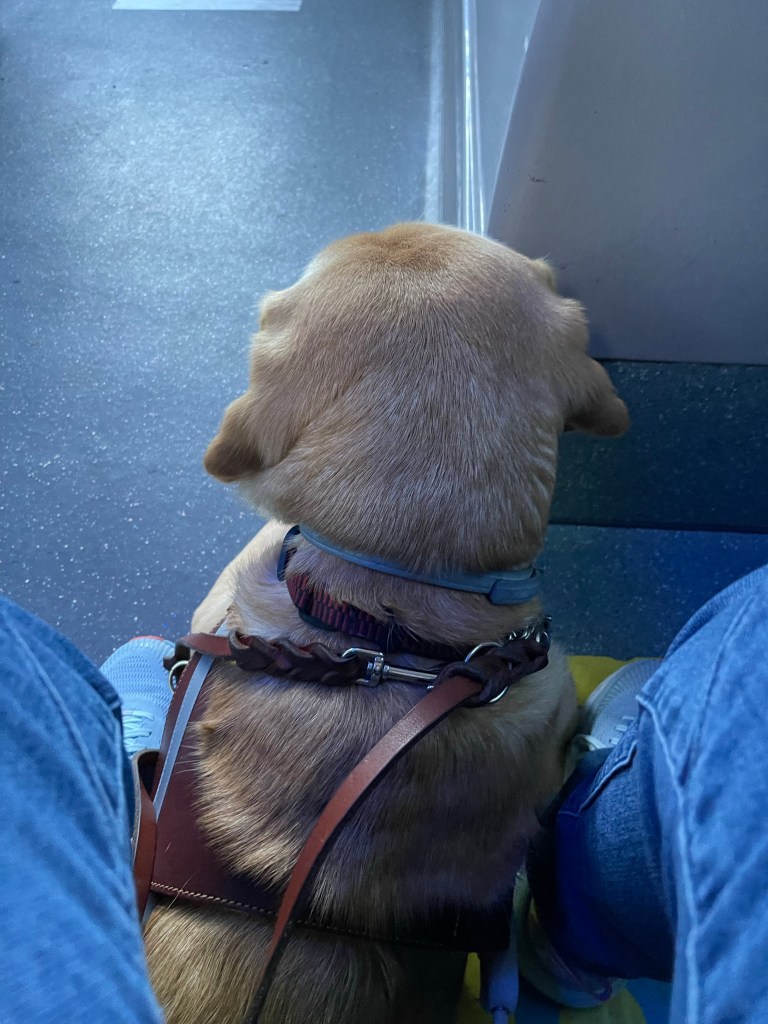
    Sienna sitting in under my seat in the bus.

    His response was to look at my guide dog, raise his hands and shrug, repeating, “you saw it”. I didn’t know how to respond on a bus with other passengers on it, so I swiped my bus pass and asked Sienna to find a seat.

    This interaction has made me reflect on public expectations of those with low or no vision. The reactions I mostly encounter are the expectation I can either see nothing or everything (and I am training the Guide Dog I work with). If appropriate, I will try and explain. Still, the part that seems complicated for others to fathom is the spectrum and variability of what I can and can not see, depending on many other factors.

    This is the first time a person has thought I had been faking vision loss. In hindsight, I would have loved to ask the driver why he thought I could read the sign yet still asked him. I suspect the answer will be because I knew when to flag down a bus, which was a rather large blob compared to all the cars. I believe this type of assumption reinforces some of society’s deficit view of disability.

    On reflection, I may have contributed to this earlier in my life, hiding my vision loss, for example, by not using a white cane when I probably should not have been viewed as different. I started to use my cane full time when I injured myself tripping over things, yet in hindsight, not having the stigma attached to it and starting use earlier would have been much safer. I was going out of my way to look sighted to fit into society as society expected.

    Now, as someone reasonably well established and sure of my place and disability, I look back to early in my vision loss journey, when I felt like a fraud in both the blind and sighted community. I was pretending to be more sighted than I was to fit in but didn’t feel I was “blind enough” to be considered part of that community either.

    This illustrates not only society’s common perception of Blindness (often a have or have not sense) but also the views of the blind community where there is a delimitation between low vision and total blindness and multiple definitions around the world.

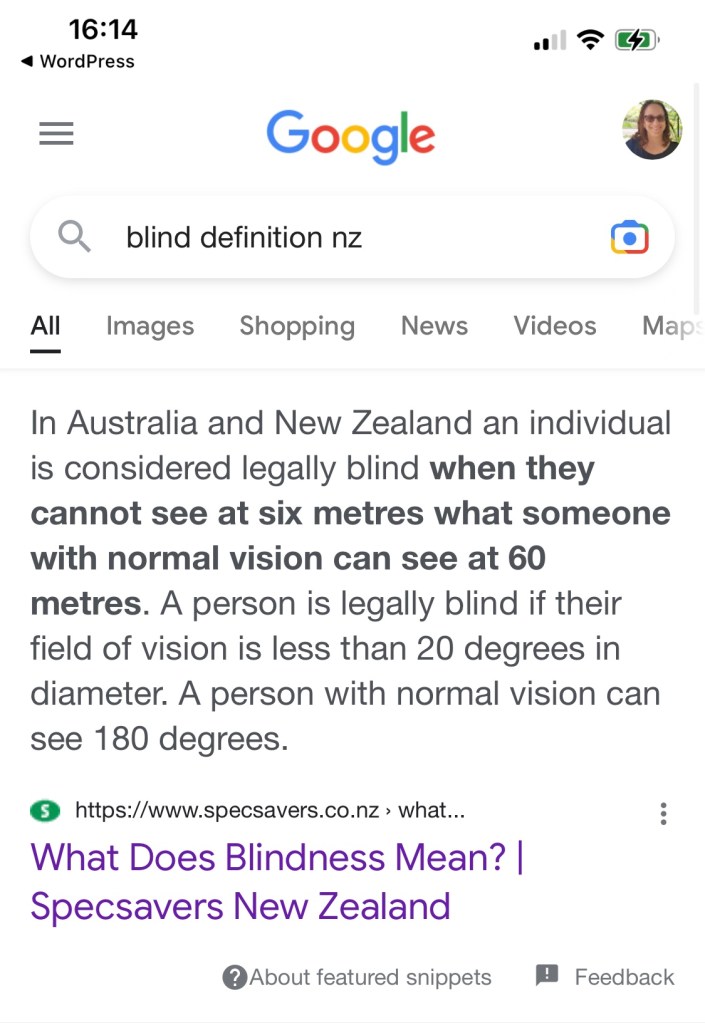
    Here is an example. I searched for the World Health Organisation definition ( https://www.who.int/news-room/fact-sheets/detail/blindness-and-visual-impairment) of the blind when writing this post. The definition that they had on their website only referred to visual acuity and not the field of view, thus only acknowledging a subset of those who are considered blind in many countries. The below excerpts (photos) show Australasian definitions.

    Legal Blindness (Google Search):

    First definition in Google with Blindness and NZ

    Blindness (NZ Government Departments):

    From the Cost of Vision Loss in NZ Report in 2009.

    Back to our assumptions. It is common to have assumptions or notice similarities or differences and we learn from these. However, as the above example and definitions show, there are varying perceptions of blindness from legislation to individuals. As a result, I question, Is it realistic to expect an individual who has not been in a situation before to know and understand without using assumptions?

    I would argue having assumptions is normal. One of the key messages I give my students regularly is that we learn from assumptions it is our recognition of these as assumptions and what we do with these that is the important part.