Category: Equity

  • Today the theme of cognitive load associated with low vision when interacting with the world continues. However, the focus has shifted from describing and questioning the problem to giving two simple real-world examples where a slight change from motorists could make a big difference to someone with low vision.

    Last week I posted a story to Facebook, which I will repeat here to set the scene.

    I took Sienna to the park as I had recently been too unwell to walk her all the way to work as usual (and still am) and she was becoming a little naughty as a result. On the way back from the park, we encountered an obstacle. I did use the Snap. Solve. and Send. App (https://services.snapsendsolve.com/accounts/referral?code=5EU1-1-0) to report this.

    A car completely blocking the foot path, long grass blocking the verge.  The only way around is onto a busy road.
    An obstacle we encountered on the way home from the park.

    Guide Dogs are trained to avoid obstacles and thus decrease the cognitive load and visual fatigue associated with navigation of the environment.

    Guide Dog Sienna stopped to show me there was an obstacle. This one was challenging as not only was there long grass, a pole and uneven ground, but also a vehicle completely blocking the footpath.

    On a day full of glare, I find that lately, if the glare comes from above, such as a grey or sunny sky, it completely blocks my ability to see the scene. Six months ago, I would have been able to see through the glare, so even navigating a situation like this increases the cognitive processing and cognitive load for both guide dog and handler.

    One way I can get around an obstacle like this is to ask Guide Dog Sienna to “find the way” and she will find a way around. In this instance, she was hesitant because of the different hazards. Ultimately, we had to step out into the road to go around. The verge was another option, but the ground there is quite uneven. Going onto the road is hazardous in itself.

    One aspect of being a Guide Dog Team is looking out for each other’s safety. I judge the traffic and know the route and Sienna avoids obstacles. Judging traffic with 5 degrees of usable vision and decreased hearing on the right is much more challenging than when I had 90 degrees and normal hearing. Situations like this now need far more cognitive and physical energy to navigate.

    The energy consumption of navigating our community was something I may not have even noticed a year ago. However, this is often a challenge; what is hidden is the impact this can have on subsequent activities. For example, after navigating a busy shopping mall or area, I usually am tired, have a headache, have eye strain and am nauseous and typically change my plans to go home and rest.

    Last weekend, Guide Dog Sienna and I visited a local market with her sister Guide Dog Sasha and her handler Michelle. After an hour at the market, Michelle and I were both fatigued from the business of the market and the number of dog distractions at the market.

    Guide Dogs Sasha (left) and her sister Guide Dog Sienna while we were waiting for an Uber at the bus station after visitimg the market.

    At the market, I noticed more than ten dogs we passed in the crowd. These were of varying breeds, demeanours and behaviours and both dogs found navigating these distractions challenging. In turn, this can be challenging for the handlers as we may not see other dogs or people, couple this with a crowd and needing to manage the guide distraction while navigating a challenging environment and everyday activities like this can become less frequent and less accessible to many.

    Guide dogs are often distracted by other animals and people who reach down and pat them while they are in harness working. In their harness, guide dogs are vulnerable. They are trained not to react to situations many other dogs may respond to. In other words, they have little fight-and-flight reaction. This is a good trait as it makes them dependable in many situations, such as riding the bus or a plane, travelling on an escalator or crossing a road. However, other dogs and people are unpredictable and often, this relationship can distract the dog from guiding its handler, which requires intervention from the handler.

    Getting back to the point. The right balance of activities is vital but often does not match societal expectations due to the hidden nature of processing and fatigue associated with navigating society a disability.

    The reason this post migrated from Facebook to a blog post is what I found today. I went to get a coffee at a cafe around 1100 hrs as I needed a break from the screen at work.

    While at the cafe, I had taken a work phone call which was challenging and when we started walking home, I was still concentrating on solutions related to that call. On our way back, we found the following obstacle.

    Two cars blocking the footpath.  Other hazards such as uneven ground, puddles in the verge, banners, power boxes and traffic.
    More obstacles we encountered today.

    In the above situation, we were lucky that Sienna could find a reasonably safe yet very suboptimal route. We ended up walking through a group of parked cars, employees and customers talking and uneven ground to get past.

    The complexity of navigating situations like this back to back with vision-heavy work can be fatiguing and has reminded me to listen to my own body and accommodate in relation to this.

    The point of this story is a little forethought from others (e.g. car parking and poorly behaved pet dogs) can have a significant impact on how a person who has a disability interacts with the world.

    I hope this story has given others an insight into the challenges of navigating a world that isn’t designed or socially accepted as inclusive for those with disabilities.
  • Today has been a long day that has caused me to reflect on the influence of disability on work-life balance and the societal expectations and the impact these have on our ability to achieve sustainably.

    I will give a background and a fur baby story to set the scene. I have been quite sick with atypical pneumonia, narrowly escaping a stay in the hospital with fast talking and daily check-ins as there was no care for my fur babies at home.

    Last night I finished my last meeting at 1930 and felt energised and ready to change the world, metaphorically speaking. I went to bed soon after as I knew I had to be at work by 0730 for an early international zoom meeting.

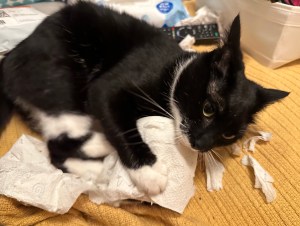
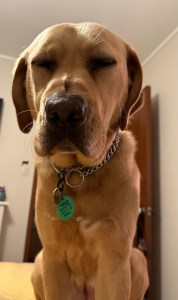
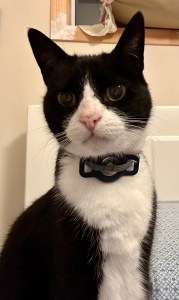
    This morning I was woken by the fur babies at 0430 because they were hungry. It started with a 15-year-old cat named Sylvester, who came and sat on my chest. When I woke, Guide Dog Sienna, who had just turned two, joined the circus, trying to get my attention. Last but not least is my younger cat Annie who found a toilet roll I had on the bed (as I still have the remnants of a cold) and decided to attack / shread this.

    As someone with rapidly progressing blindness, getting enough sleep and pacing visually fatiguing activities is an essential part of self-care. I recently came across some research explaining the effect cognitive load associated with low vision and was surprised at just how much effect this can have.

    I had experienced a similar realisation about cognitive load when moving from travelling a white cane to guide dog travel. Travelling using my vision and white cane relied on more cognitive load to process the environment as I needed to find and process objects. In contrast, a guide dog avoids objects, thus, decreasing cognitive load and visual fatigue. This can be compared with a chaotic and decision-dense paediatric resuscitation where the increased cognitive load can lead to potentially life-threatening errors. Some examples of literature around this are below.

    With this and other research in mind, cognitive load affects performance. Bringing the story back to the impact of vision loss on cognitive load.

    Today I needed to go through about 140+ assignments to make sure all instructions were followed / elements included as there were differences between markers and I needed to determine the extent of the problem before I could ask for any assistance. This a very vision-heavy process that would not be required if no disparity was found in moderation. This is probably only the second time I have needed to go through this many in 11 years.

    Adding in less common tasks like this adds visual processing and cognitive load. What I gave no thought to was the impact of this visual task on my day and week after needing to do this. I had already been told that there was no extra staff this week to help and knew that we were already behind in returning work as I had been very sick and unable to moderate. So I just got on with it; a process had served me well in the past when I had more vision. However, now with less vision, I need to be more aware of the consequences. To give context, I have a total of about 5% of the visual field of a person who has no field loss.

    The personal consequences of doing this are multifaceted and include eye pain, headache, fatigue, nausea and more which often continue for a day or two. One situation I noticed today was with two people at my office talking to me while I put on Sienna’s guide dog harness and a group of about 2-4 people approaching. I hesitated between removing Sienna’s lead and putting on the harness for enough time for her to escape and follow one of her favourite people. I can usually manage the visual processing of that many people if I am not already visually fatigued. The processing, headache and eye strain did not allow me to respond quickly at this point, causing chaos around my retrieval of said Guide Dog. It wasn’t until reflecting on this situation for future prevention that the fatigue and cognitive load components of this became apparent.

    The consequences of not looking over all the assignments are potentially increasing student distress and anxiety as well as answering many more emails asking how long until results are out of dispute announcements. One dilemma this raises is what is more important, the needs of one versus the needs of many. Do I want to prevent stress, anxiety and emails, or do I add them to my workload later?

    I easily forget that I can’t always approach things the way I traditionally have. For example, I throw more of my personal time at something or spend all day on it to make it happen when it causes a new set of problems or issues to resolve later. This raises blurred boundaries and expectations around what is acceptable when taking work home to complete it.

    Is there an expectation it will be finished despite the work time available? Who’s expectation is this, an employer or employee, workplace culture or societal view?

    With low vision in mind, one of my ways to mitigate decreasing vision has been taking work home to complete. However, the downside is increased fatigue and cognitive load, so a delicate balance is required. It would be interesting to find out how others feel about taking work home to complete as an accommodation to mitigate a disability. Why this seems acceptable in some situations and not others? Is this equitable?

    A similar concept is a trend in society to expect others to do more with less on a constant or continual basis in multiple aspects of our lives.

    A consistent message has been to do more with less on many fronts, for example, in healthcare, education and volunteering. In the past, phrases like keep calm and carry on, have been valued and, in turn, may have become an expectation rather than a mantra. One could argue that this concept could be applied to other situations as the output of an action is valued more than the vehicle to get the output. I question the sustainability and wonder if this mindset influences a culture of competition, blame and inadequacy for some.

    We need a social change in areas such as nursing or healthcare to value a person and their experience on a journey rather than measuring the outcome. Suppose we continue to be conditioned to value the outcomes above over the vehicle. By subscribing to this, are we creating an inclusive and equitable culture?

    From a personal lens, I wonder how much society has influenced me to value others over myself. Or in the case of student anxiety above my health or comfort? Similarly, with a progressive disability lens, does valuing the outcome without consideration of the journey allow an equitable situation?

    I hope sharing my thoughts has provoked some thought and conversation.

  • When some of my acquaintances lose a pair of sunglasses, I hear the phrase, “I will just buy another cheap pair…”. I wish it was that easy and didn’t involve navigating a stereotype.

    Over a week ago, I misplaced (likely on the bus) my sunglasses. I did the usual things like phone the bus company and searched my home and office but came up empty-handed each time.

    Many reading this probably assume I could buy another pair of the same. I wish that was the case and will go on to explain.

    As my vision has decreased, using what I have remaining is extremely important from a safety and quality of life perspective. I have multiple eye conditions, each causing sensitivity to light and glare. Interestingly each condition requires a slightly different tint to provide optimal viewing and finding that perfect fitting and tinted pair of sunglasses is challenging.

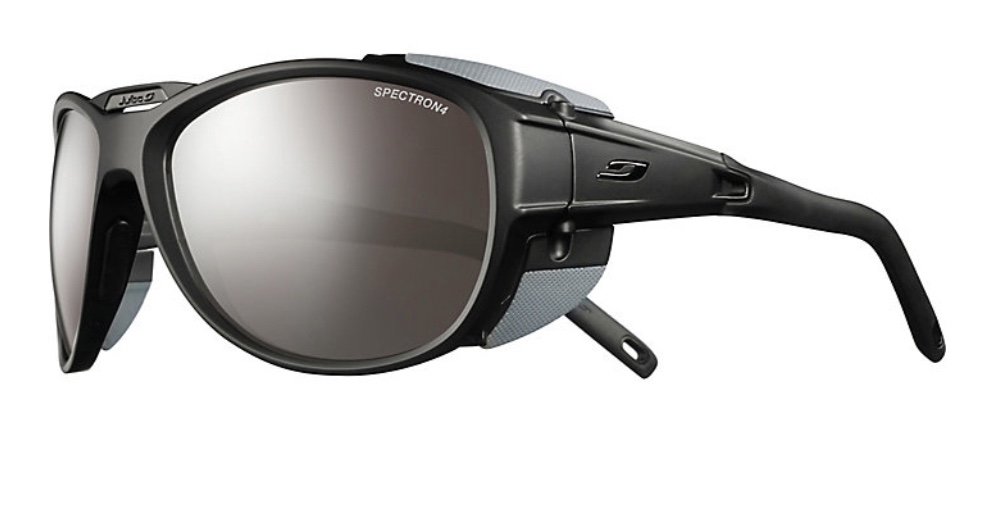
    My last pair were, in fact, the best I had found. These were the Julbo Explorer 2 High Mountain with dark brown (category 4) spectrum tint. A person recommended this particular model who has low vision and lives in the US. She explained this model decreased glare and the side shields blocked light from getting around the sunglasses.

    Although not the most becoming feature, the side shields worked very well. I have had multiple surgeries on my eye, which have altered the shape. I had an emergency iridotomy around 2009 that lets light into my eye through iridotomy, distorting what I see and putting q band of glare into my field of view. While this can not be repaired and occlusive contact lenses to stop this, our unsuccessful sunglasses with side shields made the difference between being able to function outdoors and not being able to.

    Julbo Explorer 2.0 with spectron high mountain lens
    Photo of the Julbo Explorer 2 with spectrum high mountain category 4 dark brown lens. Photo – https://www.moosejaw.com/product/julbo-explorer-2-0-sunglasses_10352650

    These sunglasses are designed for mountaineering and another particularly useful feature was the built-in venting to stop them streaming up.

    There are few places that stock this particular model of sunglasses in New Zealand and those that are out of stock at the time of writing this post.

    Did I mention the price – between $270 and $349 and sunglasses of a similar calibre and quality (but so not meet my needs) are around the same price or more.

    The part that bothers me about this stereotype is the helplessness people often associate with it, which feeds the negative or deficit construct of disability. I am an independent, strong and articulate person who would ask for help if required. However, for the most part, I adapt and problem solve to function without assistance (other than Guide Dog Sienna, that is) to navigate everyday life.

    In society, there is a stereotype of a blind person as needing assistance (helpless, potentially a burden on society etc.), totally blind, and wearing dark sunglasses with either a cane or a guide dog. I spend much of my life educating people to help them realise that most of the blind community does not match this. In that, blindness is a spectrum and is highly individual. Not everyone needs a cane, guide dog or sunglasses. As an example, I can function without these things. However, wearing sunglasses reduces pain and glare while using a cane or guide dog, keeps me safe and all reduces the visual fatigue from navigating and adapting to an environment that is designed for those with sight.

    I was surprised that the thought processes associated with a stereotype of a blind person held by some of our society have crept into my journey to buy new sunglasses. With this in mind, I would like to share my perception of my disability as a contrast.

    My disabilities do not define me; they are something I navigate to contribute successfully to society. Yes, navigating an environment built for those with good vision is difficult, fatiguing and frustrating at times, and often tasks that rely on vision take me longer to complete, but it doesn’t stop me from participating or contributing.

    However, living with a disability has also given me opportunities, such as an understanding and lived experience. Coupled with skills such as being a health care professional, educator, researcher and computer scientist allows me to provide multiple contexts while advocating for myself and others to improve our environment and societal perceptions of disability.

    Back to the sunglasses, if I could afford and somehow import the same model I had, I would. However, my investigations found this to be challenging in an adequate timeframe. As I am finding glare challenging without my sunglasses, I have spent most of the day in many suburbs across Auckland trying on different makes and models of sunglasses to find a pair that meets my needs.

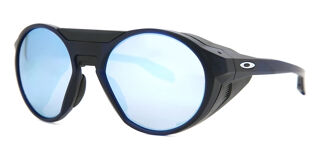
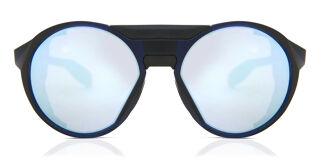
    Form and function are hard to match. The best lenses I could find were in a sport/cycling pair of sunglasses by Oakley, the Jawbreaker model, which would not have been suitable to wear to the office or formal functions. The more formal or traditional sunglasses did not provide the coverage required. The best model so far is the Oakley Clifton Deep Water sailing as they have removable side shields and excellent lenses – the downside is the cost of $379.

    Oakley Cliften Sunglasses picture from website listed in caption.
    Oakley Clifden Translucent Blue (Deep Water lens) – Photo – https://image4.cdnsbg.com/1/441/479693_1599508998135.jpg?width=320&height=160

    So the search for sunglasses continues and I am looking forward to finding the perfect pair.

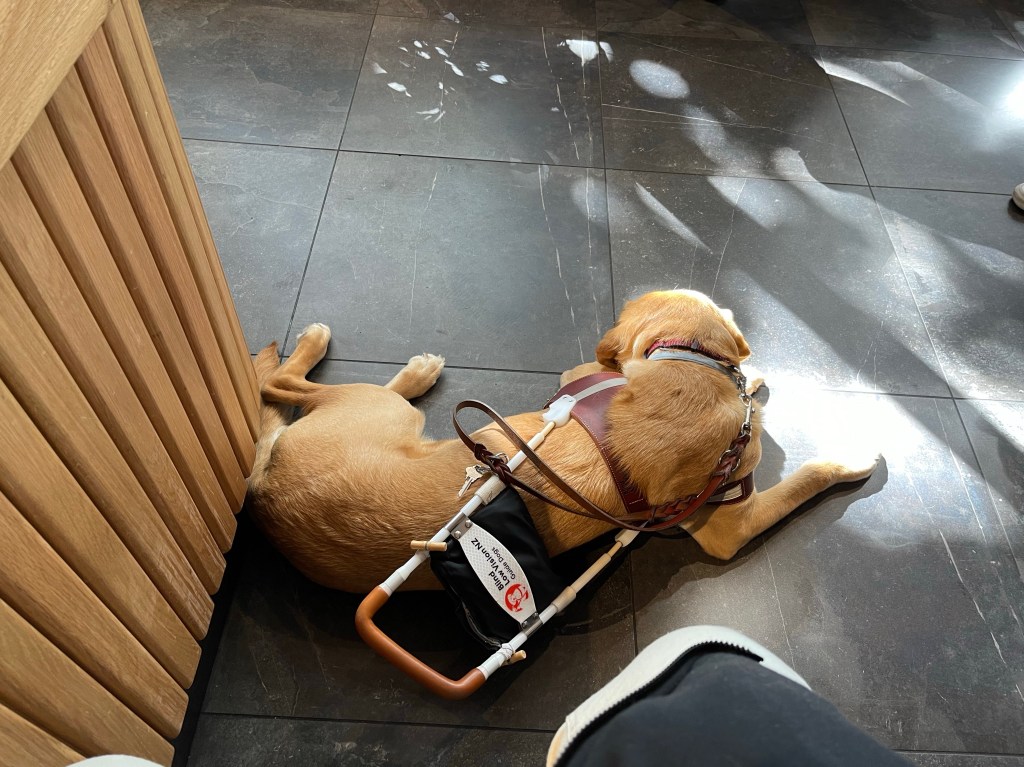
    A blog post would not be complete without a photo of Guide Dog Sienna, so below is a picture of her trying to lay in a tiny piece of the sun coming through a coffee shop window while we took a break from sunglasses shopping.

    Guide Dog Sienna in her harness laying in the sun.
    Sienna is enjoying the sun in a cafe today.
    , , , ,