Category: Equity

  • I hope others learn from the stories and reflections I share on this page. With this in mind, I would like to share a story from last week to illustrate how societal assumptions affect individuals and influence others.

    This started with a bus journey. On the way home from work, Guide Dog Sienna and I were going to get a bus as we needed to get home quickly.

    We waited at the shelter. At this stop, three routes are scheduled close together at certain times of the day (2 minutes apart). The sun was shining, so I shaded my eyes to give me the best chance to see the bus approach. Because of the traffic, it was hard to hear the difference between vehicles. As a bus came, I signalled to the driver to stop.

    The bus pulled past the bus stop; Sienna and I walked to the door and stepped in and asked the driver, “is this bus the XXX bus?”. I waited for an answer and he sat, not acknowledging me, staring forward. He didn’t answer or even acknowledge me. I took a step closer and said, “excuse me, is this the XXX bus?” He gestured upward and said, “You saw it”, to which I answered, “actually, I didn’t; I can see the bus shape but couldn’t see the number”.
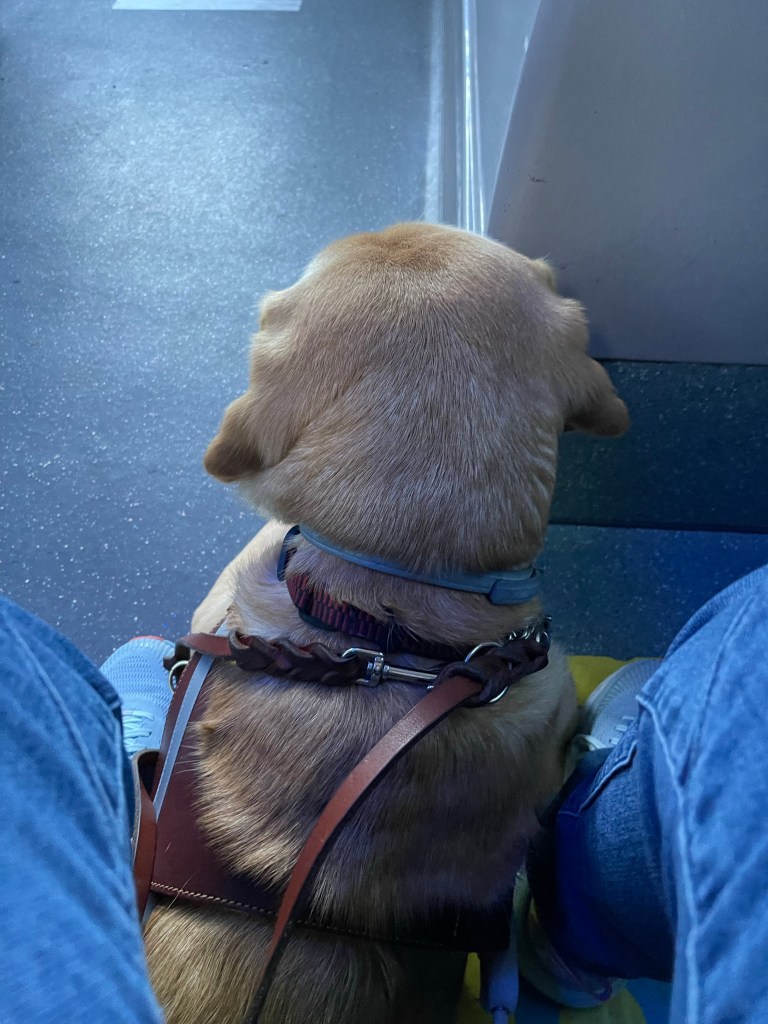
    Sienna sitting in under my seat in the bus.

    His response was to look at my guide dog, raise his hands and shrug, repeating, “you saw it”. I didn’t know how to respond on a bus with other passengers on it, so I swiped my bus pass and asked Sienna to find a seat.

    This interaction has made me reflect on public expectations of those with low or no vision. The reactions I mostly encounter are the expectation I can either see nothing or everything (and I am training the Guide Dog I work with). If appropriate, I will try and explain. Still, the part that seems complicated for others to fathom is the spectrum and variability of what I can and can not see, depending on many other factors.

    This is the first time a person has thought I had been faking vision loss. In hindsight, I would have loved to ask the driver why he thought I could read the sign yet still asked him. I suspect the answer will be because I knew when to flag down a bus, which was a rather large blob compared to all the cars. I believe this type of assumption reinforces some of society’s deficit view of disability.

    On reflection, I may have contributed to this earlier in my life, hiding my vision loss, for example, by not using a white cane when I probably should not have been viewed as different. I started to use my cane full time when I injured myself tripping over things, yet in hindsight, not having the stigma attached to it and starting use earlier would have been much safer. I was going out of my way to look sighted to fit into society as society expected.

    Now, as someone reasonably well established and sure of my place and disability, I look back to early in my vision loss journey, when I felt like a fraud in both the blind and sighted community. I was pretending to be more sighted than I was to fit in but didn’t feel I was “blind enough” to be considered part of that community either.

    This illustrates not only society’s common perception of Blindness (often a have or have not sense) but also the views of the blind community where there is a delimitation between low vision and total blindness and multiple definitions around the world.

    Here is an example. I searched for the World Health Organisation definition ( https://www.who.int/news-room/fact-sheets/detail/blindness-and-visual-impairment) of the blind when writing this post. The definition that they had on their website only referred to visual acuity and not the field of view, thus only acknowledging a subset of those who are considered blind in many countries. The below excerpts (photos) show Australasian definitions.

    Legal Blindness (Google Search):
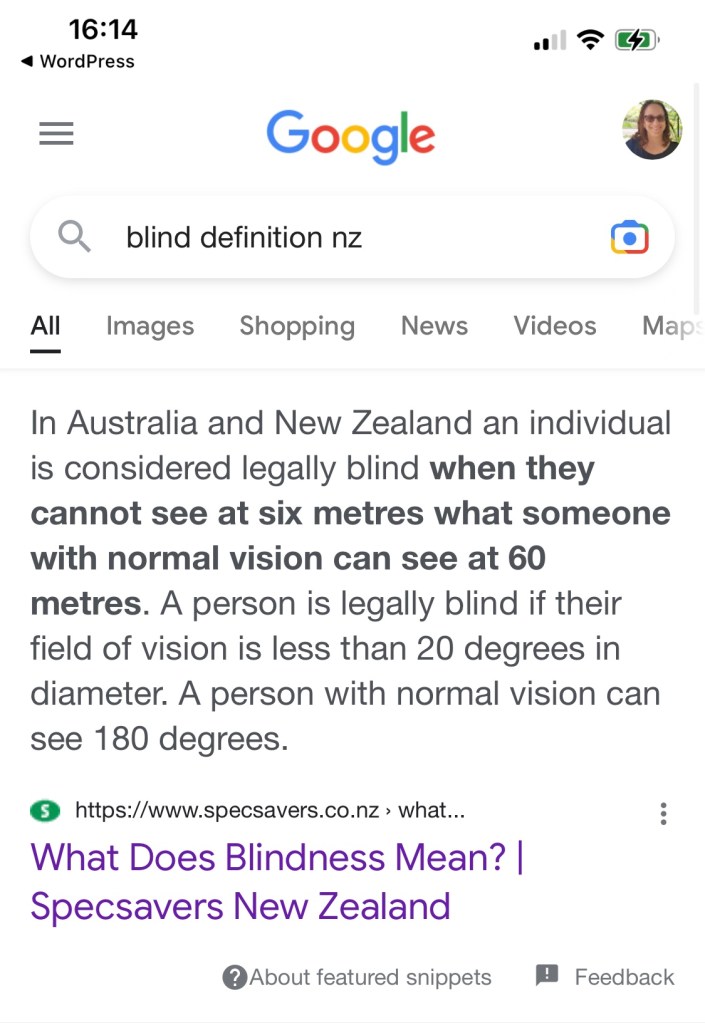
    First definition in Google with Blindness and NZ

    Blindness (NZ Government Departments):

    From the Cost of Vision Loss in NZ Report in 2009.

    Back to our assumptions. It is common to have assumptions or notice similarities or differences and we learn from these. However, as the above example and definitions show, there are varying perceptions of blindness from legislation to individuals. As a result, I question, Is it realistic to expect an individual who has not been in a situation before to know and understand without using assumptions?

    I would argue having assumptions is normal. One of the key messages I give my students regularly is that we learn from assumptions it is our recognition of these as assumptions and what we do with these that is the important part.

  • Last week I was writing an abstract for a conference presentation that looked at the perceptions of accessibility in digital health from a consumer, clinician and developer perspective and it led me to reflect on assumptions and perspectives each sector brings.

    This reflection led me to think about the impact of how much we share or don’t share about the experience of disability. How much or what do others understand in designing of access needs.

    I have spent much of my recent years trying to look sighted, hide the fact that I had low vision and get on with things because I wanted to fit in. This raises a question, in choosing not to share this information, have I made it more difficult for myself later after losing more vision and becoming medically or legally blind?

    In society, we are conditioned to keep things to ourselves that may be difficult for others, are different or considered personal or might be a burden to others. In doing so, have I made it more difficult for others to understand why I may need some assistance or rest? Similarly, has my silence contributed to the societal perception of disability by omission or stopped others from learning about the lived experience of disability?

    With this in mind, I thought I would describe what I see (or don’t) and describe some of the impacts this has in everyday life, in particular the things that society and even the blind community often do not discuss.

    I will start with the clinical information. I have one sighted eye. In that eye, I have about 5 degrees of 150 to 180 degrees of vision remaining. While in optimal conditions, I see pretty well in that five degrees. It is considered low vision and my vision varies from day to day and is very dependent on the environment.

    When people often think of blind, they immediately imagine this as seeing nothing. In my experience, what I see is often more problematic and fatiguing than what I do not see. For example, in my 5 degrees of vision, what I see is very patchy. Some parts are clearer than others. I often see flashing lights, blind spots and blurred areas, which can move considerably with the pressure of my eye (usually, it is now low five mmHg or under – 12 – 20 mmHg is optimal).

    Food for thought.

    This means continual visual fatigue; what this is like for me is often experiencing visual overload, and my brain doesn’t keep up with filling in the gaps—holding my head at different angles to get the best vantage point and squinting to be able to see an object. The result is constant neck and back pain, headaches, fatigue and eye strain/pain. I have noticed more recently that if I do any visual activity on the weekend, it takes me time to recover and to work optimally during the week. This means reducing my usual fun activities on the weekends and resting. Picking and choosing what to do or attend to and listening to my body.

    For example, I booked a matinee play I wanted to see yesterday several months ago, but the amount of visual fatigue and workload at my job meant I slept through the time I was meant to be there. I was fortunate to get a ticket for the last showing but had to pay twice and use taxis instead of the bus, which quadrupled the original cost.

    Back to what I do see. In the upper left, there is swirling light, and if I look above the midline, a band of glare obstructs what I can usually see, causing discomfort. For this reason, I look at things from a different angle and wear sunglasses a lot more than many people do and have an office at work away from the windows with dimmed lights.

    My brain sifting through all of the abnormal visual activity is very distracting and fatiguing. I have had colleagues say how you are. I often reply fine or good because explaining visual fatigue is complex and challenging for people to imagine. I have said tired; the responses I have had are things like “you are always tired” or “yes, we are all tired”, so most of the time I don’t say the extent of fatigue or anything about it.

    Another quite disconcerting symptom is nausea. When around multiple moving objects, such as a crowd, I become nauseous from the visual distortion and movement. Having Guide Dog Sienna has helped enormously with this, as I can walk with my eyes shut in crowded areas to decrease nausea and increase my confidence when out and about. However, along with a guide dog comes barriers. For example, I was denied entry to places because I have a dog, such as certain Spotlight stores and my local Dairy. Uber drivers were cancelling the job because I have a dog, even though I put in the comments I have a guide dog that sits in the car footwell.

    Guide dogs are allowed into these places, shops, public transport, and rideshare; however, some people do not understand or know of this. They assume a dog is just a pet dog. I spend a lot of my free time educating others about access needs, equity and many other related concepts in a kind and compassionate way so that people may have a little insight into why I do things differently.

    This blog post and Guide Dog Sienna’s blog and Facebook page are freely available examples of this, alongside giving presentations, discussions, answering questions and encouraging others to ask.

    I guess what I would like to get across is that we are all learning to interact in an environment and have different values, beliefs and contexts, which all add to the narrative of any situation. It is these things that add richness to our human nature and lives.

    With this in mind, I am privileged to have worked in several different sectors, including clinician, educator, researcher, computer admin, software development and I am a consumer of these with access needs that offers a unique perspective.

    Back to how this blog post started submitting an abstract for a conference that covers digital, clinical, developer and consumer or lived experience perspectives combining technical, clinical and social constructs is unique and I am hoping that this will be accepted and am looking forward to presenting on a topic that will inform on many levels.

  • I want to reflect on a couple of things in this post. Over the years, I have posted a lot about sight loss and reached a point where my vision was pretty stable at 10 degrees. Until it wasn’t, I would like to reflect on some of the experiences I have been unable to express in the hope that they will assist others on their journey.

    As a predominantly quantitative researcher and science geek, who thrives on neat, orderly processes and streamlining systems, I gravitate to the concrete, proving something is possible, and look for solutions. Over the years as a teacher, nurse, computer scientist, I have learned to work more and more in the grey areas, particularly with my patients and students. However, I never really stop trying to find solutions.

    This week the fact that science could no longer stop my sight from deteriorating sooner rather than later hit home yesterday. The hard-hitting moment started with a clinician’s comment about my Guide Dog, along the lines of you will need her even more now. With my clinician’s brain, I had somewhat guessed based on symptoms such as increased glare, seeing through what looks like dirty glasses continuously instead of the intermittently and the increase in variability of vision on a day to day basis made me think but not process what this meant.

    The most recent symptom was any sort of detailed work on the weekend made work on Monday more challenging. However, it wasn’t until there were differences in three tests over more than three months that I believed my clinical resining. The words from an expert, “there is nothing more I can do scientifically to stop this”, made this more concrete yesterday rather than abstract and distant.

    My frustration is that I have rarely found something I could not adapt to or find a solution for or be successful at or with. Modus operands have usually been to work harder, take more time, factor in transportation, and try and do better than those around me to compensate. Some examples include taking more time to complete tasks, embracing public transport, doing visual hobbies only in my holidays (e.g. painting), taking work home and finishing it there or spending over two years crocheting the blanket I planned to finish in one winter. Slowly I have been adapting all areas of my life subconsciously and until this month, this process has served me well. However, my brain isn’t filling the gaps as well as it used to and for that reason, if I overdo visual tasks, I am finding I need to stop, take a break and perhaps finish that task the next day. I have spent 11 years building a career and social life I love, yet to continue this, I need to account for visual fatigue in all I do, meaning giving up other things I value. It feels like robbing Peter to pay Paul.

    On an emotional level, this is challenging and fatiguing in itself. I wonder if it is time for the world around me to adapt more to my needs rather than my continual focus on trying to fit the mould of societal expectations around life and identity. I have long been a supporter of advocacy and rights around disability and over the last year, become more vocal. However, I have found it easier to apply this principle to others and have concluded that I need to shift that focus to myself.

    One of the catchphrases that floats around is to do things differently, which sounds easy when it rolls off the tongue, but change is not something that I and those around me find easy. One reflection in considering this is that things are challenging in the status quo and I recognise the need for change, but figuring out how to adapt what I do is something I can’t always do alone.

    On reflection, I have known my vision would deteriorate, but it had always been something that was in the future. I had anticipated things would stay how they are where I have some useful sight until after I retire, at least. I have made considerable roads into acceptance of disability and vision impairment up until now, to the point that I consider myself blind (I do meet the MSD criteria as totally blind).

    Until recently, those around me would have seen me as someone who couldn’t drive and stopped all of my extreme outdoor activities (diving, water-skiing, skiing and more), but other than using a cane, guide dog and large print and asking for an office away from windows, I just get things done.