This invitation is for people living in New Zealand.
Kia ora,
Are you Deafblind, or do you identify as having difficulty seeing and hearing?
We invite you to take part in a research project that aims to develop a New Zealand-specific definition of Deafblindness. Your voice will help shape services, policy, and recognition of Deafblind experiences — both in Aotearoa and internationally.
Who can participate?
Adults (18+) who identify as Deafblind – no formal diagnosis needed
People willing to share their experiences in a supported, accessible interview
What’s involved?
One interview (30–60 minutes) at the Deafblind Conference or another accessible time and location
Communication support provided (e.g., NZSL, tactile signing, speech-to-text, Braille, Easy Read)
Why join?
Your insights will help create a culturally inclusive definition of Deafblindness for Aotearoa and contribute to the International Deafblind Identities Study.
Participants will receive a $50 gift voucher as a thank you.
On the 1st of October, it will be six months since Guide Dog Sienna entered my life! To mark the occasion, I will write a series of posts over the next few weeks explaining the difference working with a guide dog has made for me.
It seems like a lifetime ago that Guide Dog Sienna arrived at my house. In reality, it was 1 April 2022 and we promptly began our training the next day. At the end of the training, we were released into the world and that is where much of the learning began!
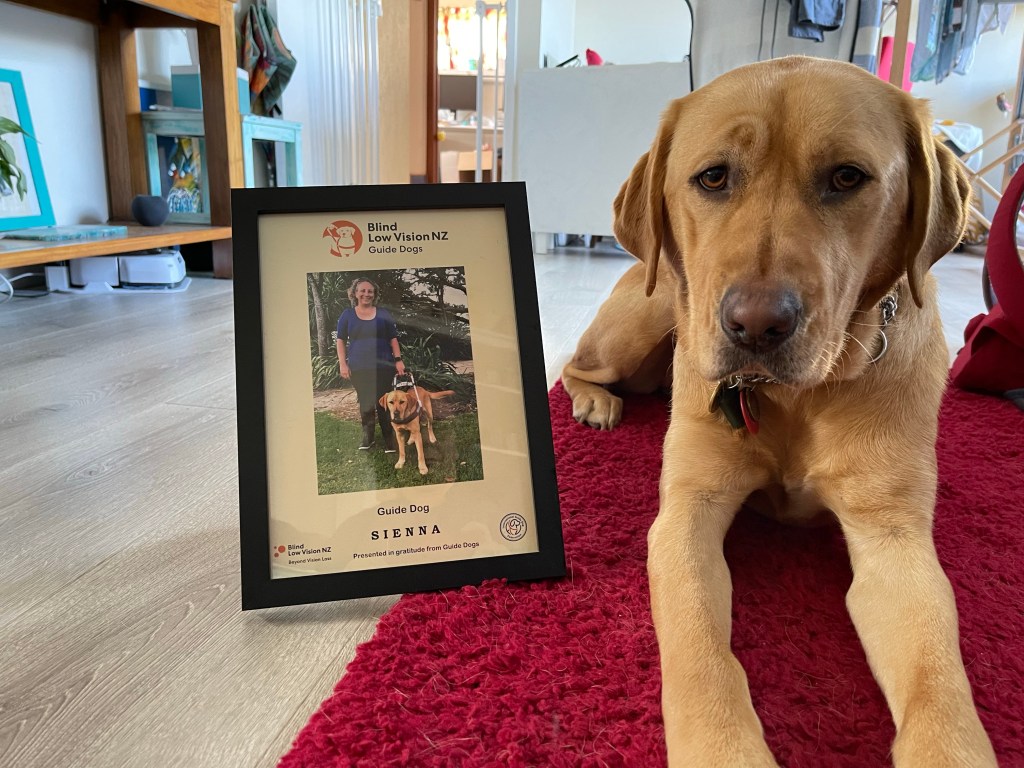
Sienna sitting next to our graduation photo – a gift when we graduated as a guide dog team.
The most significant change I have noticed is that I am more confident when out and about in unfamiliar environments. Working with Sienna has considerably decreased the fatigue associated with navigating the environment with deteriorating vision.
I will describe an example. I had not noticed that I had unconsciously stopped going out as much and was experiencing extreme fatigue due to vision changes and associated cognitive load with getting around my environment.
One particular instance where this was particularly challenging was after I got a new hearing aid and had a professional event after work with a health informatics organisation I support (about a year ago) in a part of town I was unfamiliar with.
I did my usual preparation with bus routes and arranged to call a friend to get me when I arrived at a local Pub as I was worried I would not be able to see her in a crowd so we could walk the rest of the way together. This journey meant walking through the city at dusk during rush hour. I had lost about 30 degrees of my central vision over the preceding six months and was pushing myself to keep engaging in my professional responsibilities.
I was walking up Victoria St in Auckland, there was rush hour traffic, many people bustling and dreaded road works that made the route different to what I expected. The sun was going down and reflecting of a building making it very difficult to see anything. I was using my cane but because of the new hearing aid and vision loss the visual and audible stimulation this situation became overwhelming. So much so that I needed to stop, sit on a nearby bollard and close my eyes to recover a little.
To give more context, I had about 20 degrees of vision on my left lateral side (now I have about 5-10 degrees). In this area, my vision is patchy and my brain fills in the gaps in vision that the blind spots obscure. When I am tired or in fast-moving crowds, my brain stops being able to fill in the gaps. This causes distortion, nausea and dizziness.
After five or so minutes, I continued up the road to the Pub, texted my friend and I waited for around 10 minutes. I followed this up with a phone call which went to answer phone. By this time, the street was even more crowded, so I went into the pub to look for them. There were four large areas. I scouted around all of these, hoping that one of the groups would recognise me or I would recognise one of their voices.
Unfortunately, I didn’t recognise anyone and no one called out. I went back outside where I had arranged to meet my friend and called again, getting her answer phone. By this time, the visual distortion from the crowd and traffic made me nauseous, dizzy. and emotionally drained. I was already tired from a typical work day, so I decided it would be best to go home and skip the awards dispute wanting to go. I left my friend a message saying I would get something to eat and head home because I couldn’t find the group.
I retraced my steps, realising I would need to walk some distance to get the bus home, so I stopped at a small cafe to get a cup of tea. My friend called me as I finished my tea, saying her phone was in her bag and she got my message. We agreed she would wait outside the pub. I decided to join the group and returned to the Pub.
With the fatigue associated with getting there, I found interacting with the group in a noisy social environment almost impossible and had run out of energy. In hindsight, this may have been an excellent opportunity to listen to my body and go home to rest.
However, I chose to push on my goal had been to reengage with professional obligations, colleagues and industry. We walked as a group down to the company hosting the event.
Awards were given, and food and drink were shared, but I was so exhausted I couldn’t engage at the level I usually would have. I was lucky my friend noticed and arranged a lift home for me with a colleague, as the travel to the event had left me physically and emotionally exhausted.
I had applied for a guide dog about eight months before this occurred, thinking that it would be something that would be useful later in my life. I had heard that the wait time was 2-6 years and that getting a guide dog was something of the future. It was after this that I realised that perhaps working with a guide dog was something I needed at that time rather than in the future.
If I contrast this with similar events now with Guide Dog Sienna, the difference is immense. Last week we went to Wellington to a Digital Health Leadership Summit, which was all city centre, unfamiliar routes and many people and moving objects. However, having Sienna there decreased my visual fatigue and cognitive load as she helped me avoid people and objects as opposed to locating and navigating them with a white cane and vision. This means I don’t need to use my remaining vision or interpret tactile feedback and is the difference between participating fully or in a limited fashion.
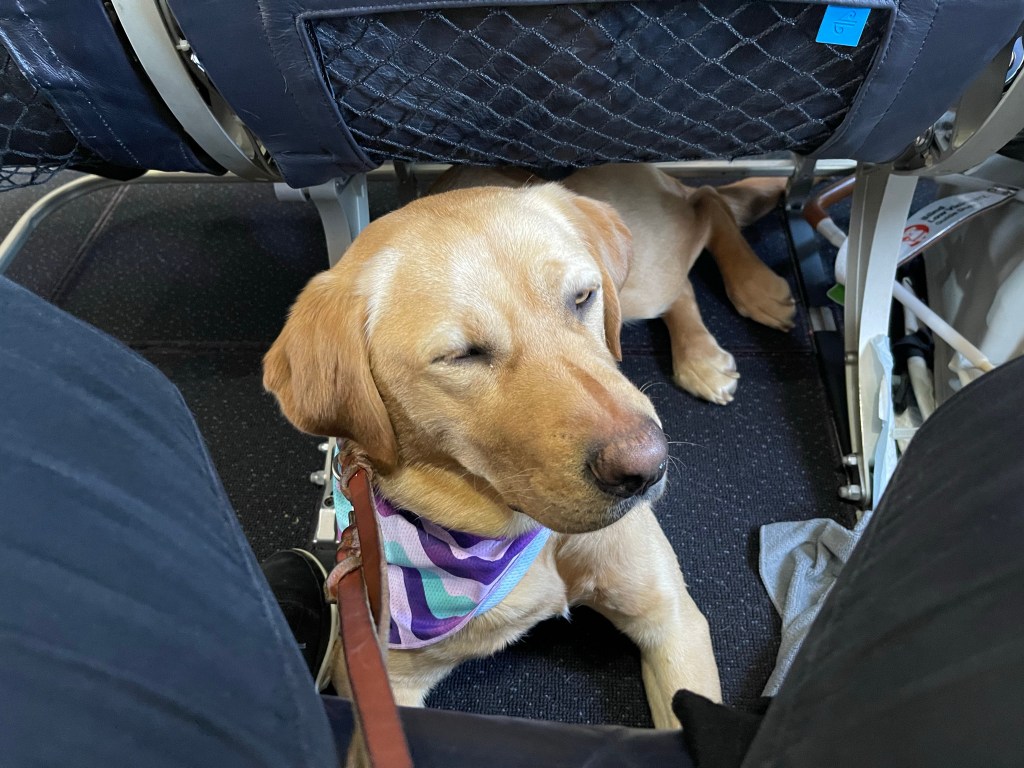
Sienna curled up under the seat in front of me on the Plane on our way home from Wellington last week.
While I didn’t attend one function, this wasn’t related to my vision or fatigue but redundancy notices at my work that I wanted some downtime to process that announcement.
So the conclusion of my first post about the difference that Sienna has made is that she has allowed me to function with less cognitive load and visual fatigue in my job.
I can’t end a blog post without some Sienna cuteness.
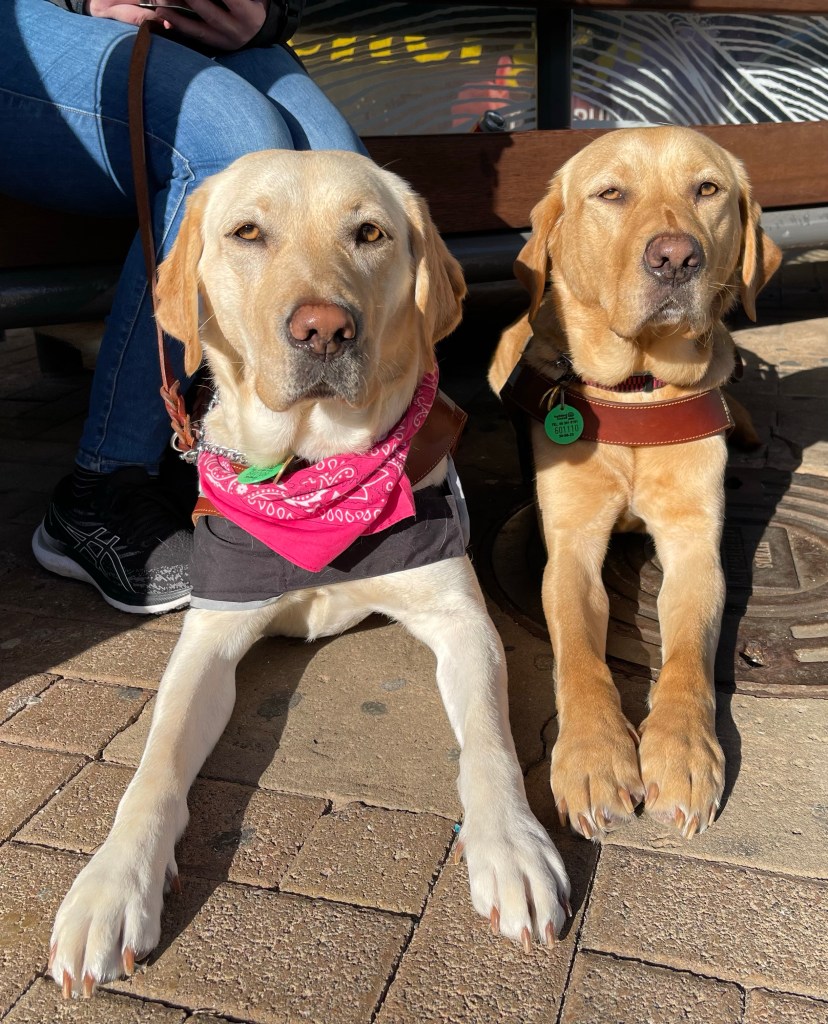
Guide Dog Sienna with her Sister Guide Dog Sasha last weekend when we went out for dinner and a show.
If I utter the words denial of service, half of those in my life will think my computer was hacked and the other half would link this with accessibility. These two varied meanings illustrate the differences in perception across our society and show the value of knowledge and education.
This post covers multiple interrelated concepts, so first, I will give a little background information about myself for context. All my life, I’ve been an incredibly outgoing person who would give anything a go, from waterskiing to scuba-diving to rock climbing, skiing and many other non-team sports—going out with friends, travelling internationally and working on very demanding jobs. This was with around half of the vision that sighted people have.
I also revelled in proving the career advice at high school very wrong. I was advised to find a job as a secretary and that being a nurse and attending university was not attainable, mainly as my eyesight made me read extremely slowly.
In response, I went to live in another country, returning and entering university as an adult and later becoming a nurse and gaining a PhD in an Engineering, Computing and Mathematics School. I tell the story to give you an example of my tenacity to point out when I raise challenges, difficulty, defeat, fatigue or other associated things this isn’t said lightly.
There have been ups and downs with my vision over the years, one of which was having my retina reattached on my 21 st birthday for the third time. Throughout, I have managed to continue in jobs that I love, progress in my career, meet interesting people and live a fantastic life. I Achieved this by working Hard not to let people notice that I had In issues with my vision, and when it became a problem, work harder to make it less visible (in hindsight, perhaps not the best approach, but it was what society accepted at the time).
There was a point in time I had to change in 2019. I lost half of my remaining vision, leaving a quarter of the field of someone with an average field. Recently I have learned that we have about 5 degrees left (of 155-180 degrees) and we have exhausted all treatments available. In a nutshell, there is no more medicine and science can do to stop or slow deterioration.
Guide Dog Sienna arrived when we began the first three tests to confirm progression and that treatment wasn’t working. While this was amidst our training together and the news and training were incredibly fatiguing, the companionship, joy, freedom and responsibility this bought was unbelievable.
Guide a dog Sienna and I was having lunch in a friend’s office last week to celebrate his birthday. This photo shows the companionship we have when Sienna is out of the harness.
To give you an idea, I had not gone out for entertainment or leisure alone (without a friend) for about five years. I hadn’t realised that my world had become so small and that I was saying no to more outings with friends because they were challenging visually. With Guide Dog Sienna since May, I have been to a play, a movie, a tour of my favourite craft shop in Mt Wellington and many other places I would have usually avoided. Last week, one of my colleagues said you are so outgoing and do so much now, although they didn’t know me 5-10 years ago as a comparison.
On today’s adventure, I wanted to go to a different shopping centre to pick up something my local didn’t have. To achieve this, we went to a different bus stop on a different route. When we arrived, we checked to see how far away the bus we needed was only to find it cancelled and the next 45 minutes away. I had also booked an appointment, so 45 minutes plus a 30-minute bus ride for what would take 10 minutes in a car wasn’t going to get me there on time.
I looked on the taxi app and found a 30-minute estimated weight which was also cutting it fine. So switched to Uber. The closest Uber was 4 minutes away. The cost wasn’t too bad, so I booked.
I messaged the driver to say I was travelling with my guide dog and could they push the passenger seat in so she could sit in the footwell. I also ask them to yell out when they arrive as I can not read the number plate. This message has served me well with no issues in the past.
I got a reply from the driver about two minutes later asking me to cancel and rebook my ride. I answered no; if I cancelled, I would be charged and he would be paid. I suggested he cancel instead.
He didn’t cancel and I could see the car in the app getting closer as it used GPS. I got a message from Uber saying your driver is arriving. A vehicle with the right colour and shape pulled up about 5m away with no movement or opening of the window or verbal communication. The car then sped off. At the same time, I got a message saying the driver had cancelled the ride.
This made me wonder if the driver came in o the site to press cancel while he was at the start of the trip, as I understand there is an option to say they couldn’t find the person. I would completely understand if the driver cancelled with a message that he had a phobia of dogs or severe allergy, but no communication, just cancellation, is poor.
The app automatically assigned another driver six minutes away. I sent the same message about the guide dog and heard nothing back, but the app had told me that the driver had read the message, so I assumed all was good. I got another text saying that the driver was approaching and I could see it on the app. A car the right colour and shape pulled into a nearby driveway (carpark entrance), paused and drove away. At the same time, I got a message saying the driver had cancelled the ride. I wondered if they had seen Guide Dog Sienna and I waiting and cancelled.
The app automatically assigned a third driver 8 minutes away. I sent my message and got a reply saying “got it” and saw it was read. This driver did arrive, called out and moved the seat forward so Sienna could sit in the footwell. He provided fantastic service. Unfortunately I missed my appointment due to drivers cancelling and the appointment had both late and cancellation fees which is super frustrating.
I am left wondering why the first two drivers cancelled and drove away and suspect it was the Guide Dog. Guide Dog Sienna is highly trained before she became my guide and behaves beautifully in public transport, taxi and ride-share. Legally we can not be denied service based on the basis of her being a dog in these circumstances.
I want to raise awareness of these rules and regulations in New Zealand for those who are not aware.
I did send Uber a message hoping they could provide drivers with education around service animals and communication. I was impressed that my message to Uber help was answered with a phone call in less than an hour. The support person reassured me that their staff do have online training about service dogs and that the two drivers would be asked to complete this again and have their app restricted until this was achieved. They also gave me the 0800 phone number of the accessibility support team should this occur again.
The crux is that even though I missed out on an appointment and paid cancellation fees, the positive experiences and changes having a Guide Dog brings far outweigh the experiences like this.
This experience has strengthened my goal of educating this around me about access needs.
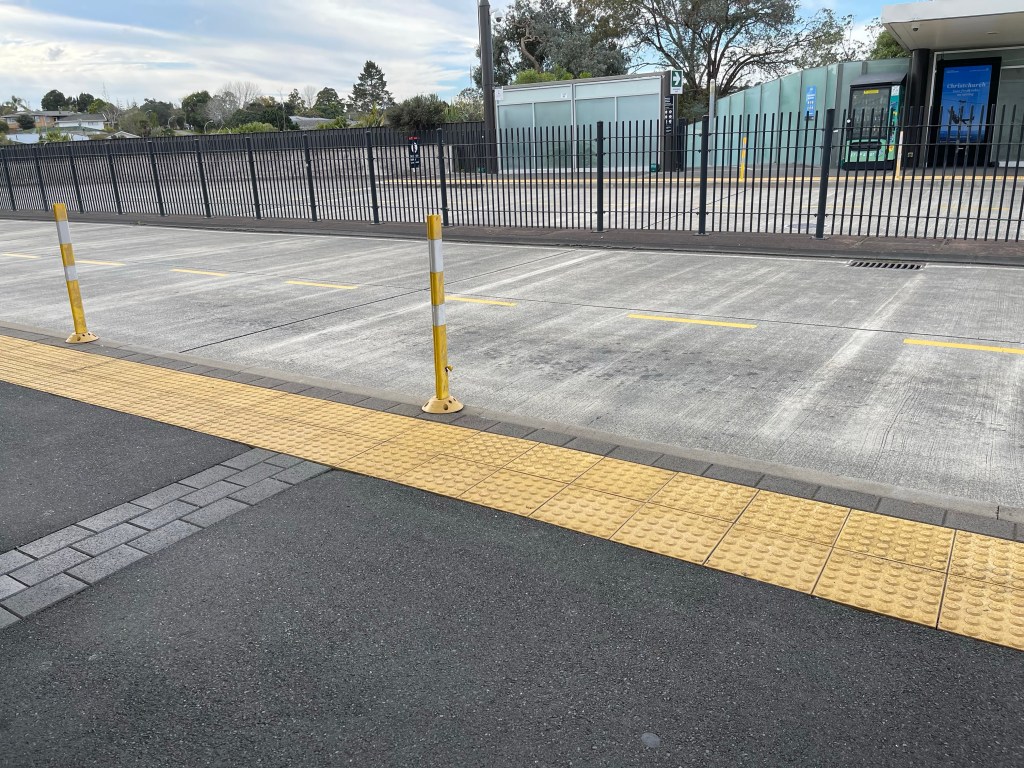
A mission for a separate day is related to educating bus drivers about needs – not just access requirements but considering everyone getting off a bus. The photo below shows the bus platform at a station near my house. I got off a bus here and the bus driver stopped so that one of the poles on the side of the platform was directly in the middle of the door.
As people were getting in as I was getting off, Sienna was watching the people and went around the pole and as it was so thin, I walked straight into it. Had the bus driver pulled forward 1 to 2 metres, this would not have been an issue. As it was, the pole is an issue for anyone, not just Guide Dog Teams.
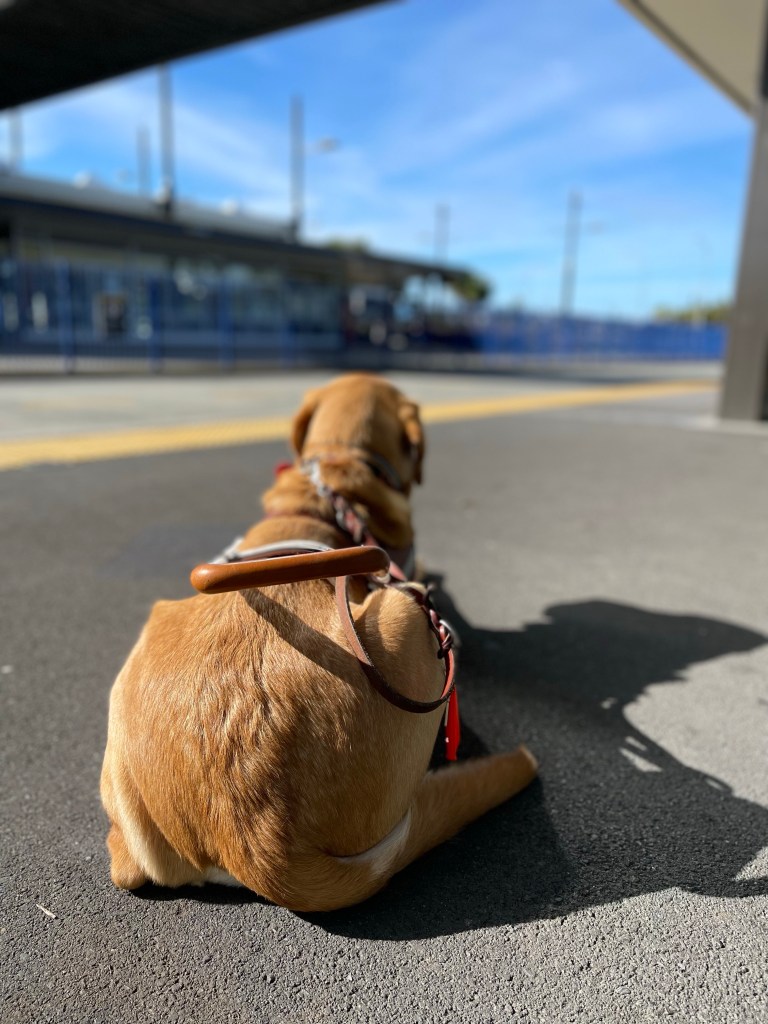
Local bus station with poles on the edge of the platform. Interestingly none of the other stations I have these blocking the way.This photo shows Sienna sitting at a different bus station waiting for a friend. Note no poles are blocking the platform!