Category: Low Vision

  • I thought I would continue along the theme of assumptions we make and judgements associated with these, along with a narrative about resilience being a rollercoaster ride.

    This reflection stemmed from an interaction with a healthcare professional today. I saw her with mild but relentless eye pain. She asked me how things were going, how my last specialist appointments went, and my MRI results. I relayed the results, discussions and a plan of having eye surgery on the next available theatre slot for this (January) to preserve my remaining vision. I proceeded to explain the surgery, risks, benefits, and success rates related to my conditions and what I was putting in place to promote the best possible outcome based on the research I had read. For this, I got the label “science geek”. At the time, this seemed like an excellent complement, but my response was rather superficial and detached in hindsight.

    When I got home, I recalled my blog post last week, where a member of the public told me I was “amazing” for managing to walk around a rubbish bin that was on the footpath. At the time, I was a little taken aback and quickly pushed this aside as something simple and applied my own assumptions of what I considered amazing, such as getting my PhD, being published, loving my job and passing on my knowledge. 

    This prompted me to analyse an earlier conversation with a healthcare professional and made me rethink my reaction to the difference in perspective about success. 

    The earlier conversation covered planning my needs post-surgery as I will not see much (which will prolong the uncertainty around the success for some weeks after). In this conversation, I was asked what I needed help with. At face value, this question seems simple. However, even as an experienced nurse, I wasn’t really sure what I would need. I could guess and, as a result, kept unconsciously relating things to how I see now and not what it will be like post the surgery. This included thoughts of I can do that, I don’t need help with that, or someone might need assistance more, or there is always someone worse off, which are my go-to responses.

    It wasn’t until she used more concrete terms and bluntly pointed out that she thought that I needed “urgent” referrals for daily tasks that I began to realise this wasn’t going to be as easy as I thought. Changing my mindset started with being asked the following two questions: 

    • Do you think you could make toast safely when you can’t see the toaster?
    • Have you ever made a cup of tea without any sight?

    To both of these questions, I paused and then replied – “I don’t know”. It was not until this moment that I realised that practice, tips, tricks and techniques were required before the need for them. As a nurse, it is logical to forward plan and assist others to prepare for their recovery as much as possible. However, applying this to myself as a patient who had not previously experienced total blindness was not as easy as I initially thought.

    She then asked about how I would get to follow-up appointments and even after the above realisation, my automatic problem-solving response was, I will get a taxi. Then she asked me if I had thought about how I would get into the building from the taxi on my own with no vision? My automatic response was that I already use a long cane and will be OK, but the truth was that I had not thought about it until that moment. What had not sunk in was that I use the cane with some vision, not with no vision, and these were two different experiences requiring different approaches.

    Photo by Castorly Stock on Pexels.com

    At this point, I noticed my thinking was as a nurse, not a patient. My mind was speeding through multiple potential problems and analysing these to find the best solution. As someone who is usually independent and confident in what I do, this conversation and analysis made small tasks such as making toast uncertain and seem impossible.

    In fact, a more robust approach would have been to turn off “nurse mode” and slow down, start asking questions to understand better what to expect, and then formulate a plan. 

    Yes, Shayne – if you ever read this – we discussed this just today in another context.

    Writing this has shown me that we all make different assumptions and what we do with these is the important part. Perhaps I will now need to start changing my focus so that the smaller tasks such as making toast and navigating a rubbish bin on the footpath are seen as a success.
    , , ,
  • I was reminded several times in the last week how our assumptions can influence and impact others. There are two examples of this I would like to discuss. The first was challenging my own beliefs when I went to a Christmas Concert featuring the Auckland Symphony Orchestra, among other performers. The second was the assumptions of others.

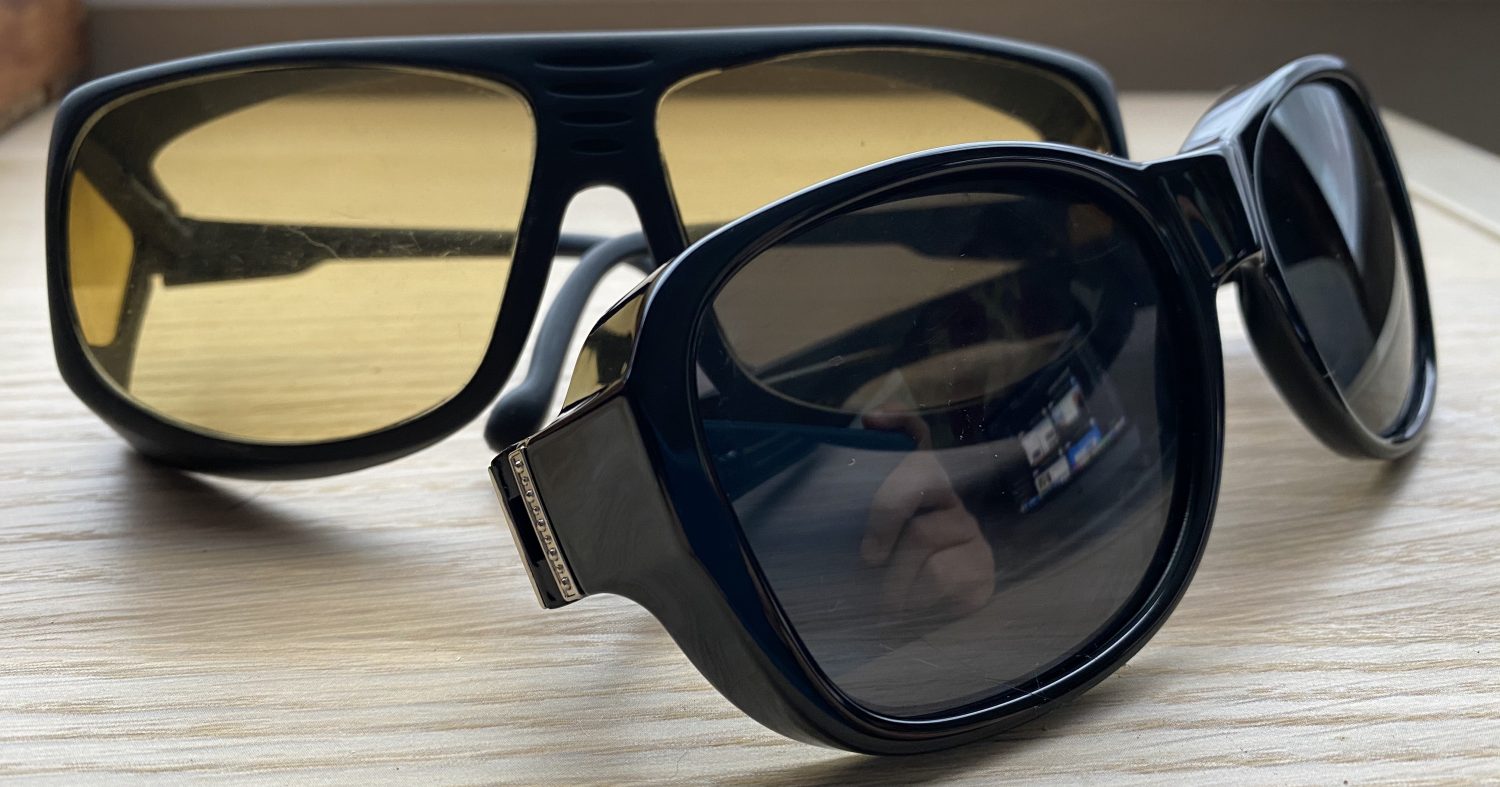
    At a Christmas Concert on the weekend, I found myself wearing sunglasses when I usually would not have needed to. It made me recall some assumptions I made as a child of around 13 years old. I typically associated a blind person as someone who could not see anything, wore boxy blacked-out glasses indoors, at night, and outdoors and needed to tap around a white cane and had to have help with “everything”. Over the years, I had learned that this assumption was not the norm. However, thoughts creep back in at times, and I need to remind myself that my assumptions are not necessarily generalisable. This experience caused me to reflect on why I was wearing sunglasses when I was wearing them and how much these helped me.

    Two pairs of my sunglasses.

    I realised that I was “just like” the assumption my 13-year-old self made, which was slightly confronting and made me consider how I wanted to be perceived: a confident, independent and well-rounded person who gets on with what she needs to do without bringing attention to herself.

    This led me to reflect on how I wanted to be perceived and why I was so afraid of being recognised as blind (or low vision) – or in a nutshell, as different. I concluded that this was because of societal perception of blindness as a deficit (as an aside, I am an academic struggling not to link this blog post with a theorist, model or research but continue it as an informative story of life). In true academic fashion, this led to more questions than answers, so I decided to present the beginning of my list:

    • Is low vision actually a bad thing?
    • Why is it often depicted in that manner?
    • Why do I often believe it is “bad”?
    • How much has society had to do with this assumption?
    • How and why did society come to those conclusions?
    • Why do I revert to believing these societal norms?

    I didn’t want to be known as the person with “low vision” or “can’t see” because this mindset is a deficit, where society seems to hold different standards.

    For now, I will park the theoretical component of these questions and explain how these concepts relate to my experiences. Over the last six months, in particular, I have noticed my visual field getting smaller and have not been seeing some things around me. Interestingly, I feel I have been conditioned not to let those around me know or help when I find things difficult and get on with things myself. For example, in a crowded meeting, today people got up and moved towards the door, leaving a wake of scattered chairs which I promptly fell over. My response was to get up and continue with my day and fly under the radar.

    A prime example of lower standards occurred when I walked to work on Friday (rubbish collection day). There are usually multiple wheelie bins on the footpath. While these make annoying obstacles (and I need my sunglasses even to see them), they are necessary for life in the community. As a response, I tend to use my cane more to determine how far away they are. During my walk, I was passed by a woman and smiled, saying good morning and kept on walking. About 20 metres down the road, she stopped me and said with conviction: “I think you are amazing”, going on to say, “I watched you get round those rubbish bins … you are just amazing”. I didn’t know how to respond and opted to say thank you and kept walking.

    This person had made a few assumptions in her statements, and I was left feeling that I was being judged for my low vision (I do acknowledge my assumption here). I thought about this for the rest of my walk to work, and it cemented how much assumptions prevalent in society can influence your own self-perception and, in turn, self-esteem. I want to think that I am amazing at contributing to the community rather than navigating around a rubbish bin. While I measure myself against my contributions to society as a person, academic, nurse, volunteering, project work and as a leader in my own right, it would appear based on assumptions others may have much lower standards.

    Tattoo with binary code that says "I am enough"

    This comes full circle to how I respond to these assumptions, in other words, what I can control and what I can not. I have concluded that all I can control is how I perceive myself and decide to promote myself to the world. I want to be honest and acknowledge that my response is that self-perception and esteem are impacted by societal assumptions. I often set myself very high expectations to counterbalance the deficit model described above.

    To remind me of the influence of society, I recently got a tattoo where I can carry a message to myself as a constant reminder. I will let the readers decode the tattoo, be aware that I have left the first four digits off of each row.

    ,
  • Today I would like to talk about the changing landscape both figuratively and literally.

    After finishing a long day at work today, I had three events to attend for professional organizations I support related to my job.

    Two of these were in the city. I do go to the city campus of my workplace at times. However, the campus and vicinity are familiar and I don’t generally venture far from it.

    Generally, I’m fairly confident navigating my way around, finding where I need to go, and getting there. However, today was a very different and confronting experience.

    It was the first time I had been to this particular area in the city for around 18 months. The landscape had completely changed.

    Over the last six months, my visual field has decreased significantly (you can read about this in my previous post). While I knew the area I was in, it was very unfamiliar. I had been there before it was when I had much better vision and in my mind, I expected that the experience of this area and the layout would be very similar to the last time.

    This expectation was far from the truth and my experience was considerably different. I knew where I needed to go but getting there was challenging and physically and emotionally exhausting.

    Imagine when you are tired, yet your environment continues to overstimulate you. You try to track everything around you to ensure you remain safe while navigating with one eye closed and looking through a cardboard tube with the other.

    One particularly frightened me was the addition of painted bike and scooter lanes (on the footpath). Where people and fast-moving vehicles darted unexpectedly to avoid each other. I tried to keep track of everything around me but found it so overstimulating and visually challenging that I just had to stop for a while before setting off again.

    To combat this, most of the time, I navigate my environment systematically, but today this approach did not work.

    I finally arrived where I was meeting friends and colleagues; I entered and walked the perimeter of the rooms to find my friends. I couldn’t see any of them. I did another circuit and decided to go outside and call, no answer; I texted and waited 15 minutes. It was cold and windy outside, so I decided to find somewhere warm, get a drink and wait for the next function to start.

    It struck me just how isolating restricted vision can be – particularly when technology can’t help. What began as an easy adventure had become challenging because of the changes in my vision.

    Photo by Pixabay on Pexels.com

    I eventually did manage to meet my friends, they were sitting in one of the rooms, but I did not see them despite walking past. I couldn’t express just how fatigued I was getting there and cried when I found them.

    What this has reminded me of three things. Firstly, the need to conserve the use of my vision. Secondly, my expectations and ability to thrive in busy, crowded and unfamiliar environments might need to change. Lastly, that these changes aren’t a failure but a new beginning.


    , ,