Being independent was something I used to take for granted.
Over a year ago, I decided to stop driving as my visual acuity was variable and was consistently below the driving threshold. Even though health professionals stated that they were still happy for me to drive as I was ”sensible”, ”knew my limits”, and had ”already stopped driving at night”, my self-awareness, values, morals and knowledge of the potential consequences to myself and others led me not to drive.
At first, using public transport was a novelty, with journeys taking longer; I enjoyed the change of pace and found that this enforced downtime relieved stress.
Lately, I have been becoming more frustrated with the amount of time or money it takes me to get places and complete everyday tasks like grocery shopping, pick up a prescription or, as discussed in an earlier blog post go to Yoga. A simple trip to the doctor when feeling unwell (leaving work at 1630 hrs) means a very long night. Driving, I would have been home at 1800 at the latest. Using public transport meant two busses to the doctor. As the pharmacy was closed when I had finished at the doctor, a further two busses were needed to get to the after that hours pharmacy and an Uber home from there. I arrived home at 2055 hrs.
This shows a barrier to being spontaneous and the need for planning to achieve many tasks that I used to be able to do without any forethought. The need for my independence to be “enabled” by external people or services has been difficult for me as my idea of independence is also being self-sufficient. The switch from complete self-sufficiency to reliance on external entities has felt like a loss or defeat at times, with a niggling feeling of being a burden to others. While one could argue this was negative self chatter, the barrier itself exists. This means that until self-driving cars or teleportation become a reality, complete self-sufficiency is impossible for me.
What I plan to reduce is the self chatter thoughts of diminished self-worth related to loss of independence. Furthermore, becoming more organised with planning as second nature may decrease the stress related to transportation.
On handing in my PhD, I decided to go back to something I love, Yoga classes as a reward for submitting my thesis. Today I am wondering if this, in fact, a reward or a punishment?
The Yoga class is fantastic and a great Yoga studio, however, the accessibility makes this less of a reward. I last went to Yoga classes when I could still drive – making this a very convenient; however, no longer driving makes it difficult.
Option one (what I did last week): Taxi (Uber or Ola) home from work (10 mins), taxi to yoga (15 mins), yoga class (75 mins) and taxi home from yoga (15 mins). What this means is a total of just under two hours which seems reasonable.
That is until you add up the price. Taxi home from work ($12) Yoga class ($25), taxi to yoga ($18) and taxi home from yoga ($18). This means that I pay $73 for a Yoga class that is supposed to be a reward. This price for one Yoga session is not sustainable.
Options Two (what I did today): bus to the station ($2.50), bus to yoga ($2.50) yoga class, ($25), bus to the station ($2.50), wait at bus home ($2.50). That works out at $35, which is much more reasonable until you look at the timeframe.
Walk home from work (30 mins), change (5 min) and walk to the bus stop (5 mins) bus to the station (15 mins), wait at the bus station (up to 30 mins) bus to yoga (15 mins) walk to yoga (5 mins), arrive 25 mins early due to the bus schedule (25 mins), yoga class, (75 mins), walk to bus stop (5 mins), wait 25 mins for bus (25 mins), bus to the station (15 mins), wait at bus station (40 mins), bus home (15 mins) walk from the bus stop (5 mins). Adding up the minutes, this is five hours and means arriving home at 2200 to make dinner and go to bed all for the reward of one Yoga class.
What this illustrates is the cost of having a vision impairment, not only in terms of money but time as well.
When I could drive and get around in the dark easily going to a Yoga class was simple. Now it is a little more complicated and means weighing up the price, time and risk associated with getting around at night.
I am a “part-time” white cane user what this means is that I use my white cane when I need to and put it away when I don’t. Being a cane user (mostly at night) is only recently something that I have become comfortable with sharing with others. The problem with this is that people do not understand that a person can see and need to use a white cane.
An example of this occurred on the way home. I was at the bus station, and because of the fact it was after 2100, it was dark, the lights were bright, and the glare was a big problem I was unable to read the bus number. The platform I was waiting at was expecting several busses at that time, so just getting on wasn’t going to work. A bus approached, stopped, another passenger got on. I used my cane to tap the bus step to judge the distance (while the driver watched me), said “Hello, is this the 923 bus?”, he pointed to the sign and said “read it.” while looking directly at my white cane.
I was quite distressed by his actions. I scanned my Hop Card and went to take a seat. On reflection, there were several options I had at this time. One, confront the driver and tell him that I thought this was rude; explain and educate him, or ignore this. I could have opted for interacting with the driver regarding this but after a day at work, and spending a further 5 hours on having to a Yoga class, it wasn’t worth the effort.I considered the first two options, but as other passengers were waiting for the bus, I chose to do nothing.
What I want to illustrate with this is that there is a cost associated with having a disability. Furthermore, at times, it can be more than a monetary value, it can include, time, effort and the need for resilience.
Getting around in the dark is something that I have been unconsciously avoiding for quite some time now, but it was not until last week that I realised just how much. I will explain a little about my vision and then relate this to getting around in the dark.
For those who have read about my vision, you will know that I have some vision loss. Here is a quick overview, I have good central vision in my left eye and can see a small slither of light at the bottom of my right eye. My vision changes depending on the light, time of day, how tired I am, what I have been doing (e.g. reading) and I am very susceptible to glare with decreased visual acuity in the dark.
Several things impact getting around; the first is that I have no depth perception which is caused by having monocular vision (or only having vision in one eye) and decreased peripheral vision in my left eye. Essentially this means that I see the world as flat with less in the central nasal area where I have a blind macaroni shaped patch. Monocular vision is similar to looking at a photograph or two dimensional image.
As an aside here, ironically my PhD topic has a component around computer vision, and part of this is transferring two-dimensional points to three-dimensional representations and back again, anyway – back on topic.
No depth perception means that I need to interpret what I see using techniques that are different from those who have binocular vision, what I have found is that at times I consciously need to stop and think about the environment when it is unfamiliar or where there is sudden or unexpected movement. One place that I particularly have difficulties is in crowds. I love shopping but find shopping malls are particularly tricky as they are crowded. In society today other people are often walking in a group, looking down at their phone and – dare I say it – are often self-absorbed. I do my best to move out of the way, but at times I find myself, bumping into people, their reaction is often that I am being rude and not looking where I am going.
If I am in a crowd for more than five minutes the movement of others around me causes me dizziness and nausea, and this has led to me avoiding shopping malls and supermarkets unless necessary and doing most of my shopping online. One of my strategies, is to walk directly behind another person and to walk where they walk. This generally works well, however, when out with friends this doesn’t make for the best social situation.
Another challenge is at events such as graduations. I love to see my students graduate, but find the crowds and glare very difficult. For this reason, I have been asking other staff members attending if I can hold on to their arm in the crowd. Asking for help was a big step for me at first, mainly because I needed to admit that I needed assistance and stop trying to hide it. What I learned was that my colleagues did not seem to mind this and my thoughts of it causing problems were unfounded.
The second thing that influences getting around is glare. Last time I discussed it with my retina specialist, he said, “that’s because you have a blonde retina”. However, I believe the majority of susceptibility to glare is multifactorial, for example, a little from each medical condition retinopathy, glaucoma and post cataract surgery. The sensitivity to glare is not solely related to the eye conditions but also influenced by side effects of treatment to retain my sight along the way, for example, an iridotomy, retina laser, a lens implant and more.
Last week I needed to be across town for a workshop at 0830, on public transport this meant leaving before 0600 when it was dark to catch two busses and a train. While walking to the bus stop I came to the realisation that I unconsciously avoid going anywhere in the dark, or if I do it is usually with friends or in very well lit places.
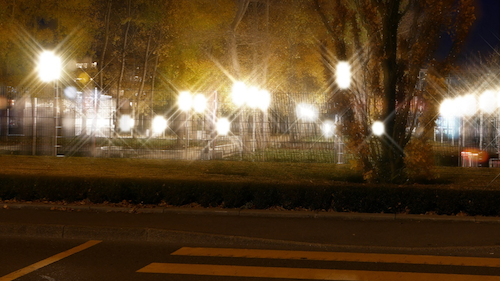
While walking to the front gate, I tripped on the footpath on a crack in the pavement that I knew was there and usually manage to avoid (good start). The next issue became the glare and starbursts around streetlights. I was always told that the halo and glare effect around streetlights would get better after having a cataract removed; in fact, I have found the opposite, it is much worse. The photo below shows glare, halo and starburst light and I find at different times I have a mixture of all of these with the glare and starburst being the most prominant.
The below photo is of presbyopia which is usually only possible in people who have binocular vision, but this is the closest representation I can find of how the glare splays out from lights and sometimes across my whole visual field when I look straight or up changing the tension on my retina.
Back to the story from last Wednesday morning. Oncoming traffic, coupled with streetlights made it impossible for me to make out anything around me which caused me to walk off the side of the footpath. Until this point, I had not realised just how much I adapt my life so as not to be outside of my house or work in the dark. Interestingly, the glare has probably been this bad for the last year or so but I had not been in a situation where I had needed to manage this alone or where it had been that dark.
I have been doing some orientation and mobility work with an instructor from the Blind Foundation and she had introduced the idea of a white cane for use when I needed it (e.g. at night). I had been learning how to use a long cane and felt safe in learning to use this for “future use” and had got to the point where I knew some of the basics but had not fully accepted that there were, in fact, times I would need to use it. Accepting a cane (even if it is only for use in the dark) is a big emotional step. There were so many fears, for example, that I would be labelled, that others would be confused as I don’t use it in the day and do at night or in crowds, that it was a sign of defeat or dependence. What I really should have been doing was flipping this dialogue, for example, it warns others I might not see them and is a sign of independance but at that time, I did not feel ready to do this until reflecting later.
I did pull out my cane and use it to get to the bus stop and I found it easier getting onto the bus. The most important part was that the tactile feedback I got from the cane was keeping me safe. The majority of my training had been in situations where I could see large objects such as the road, bins etc., so the cane was giving me secondary tactile information. In this situation I couldn’t determine objects, so needed to rely on the cane to give me primary information which was a new experience for me.
On reflection, until this time, I had always been with other people when out in the dark and when on my own there has been enough light for me to see enough to avoid things like walking off the footpath into the road. In other words, I was unconsciously managing my safety. What I have now learned is that I need to make a conscious decision to risk assess before leaving the house and anticipate any environmental needs such as glare and the dark instead of doing what I have always done, just walking out the door and problem solving along the way.
I am trying to come up with a witty catch phrase around being a part time / night time cane user but am having difficulty formulating one. Something along the lines of “Full time …, part time cane user.” If anyone thinks of a witty catch phrase let me know.
I hope that this story helps others to learn from my experiences.