This week I was reminded just how changeable my vision is in a day. I will tell a story to illustrate.
One of the catchphrases in the blind community is that blindness is a spectrum, which is accurate. What is usually even more unexpected is the changeability in that spectrum on any one day. I had sometimes forget myself.
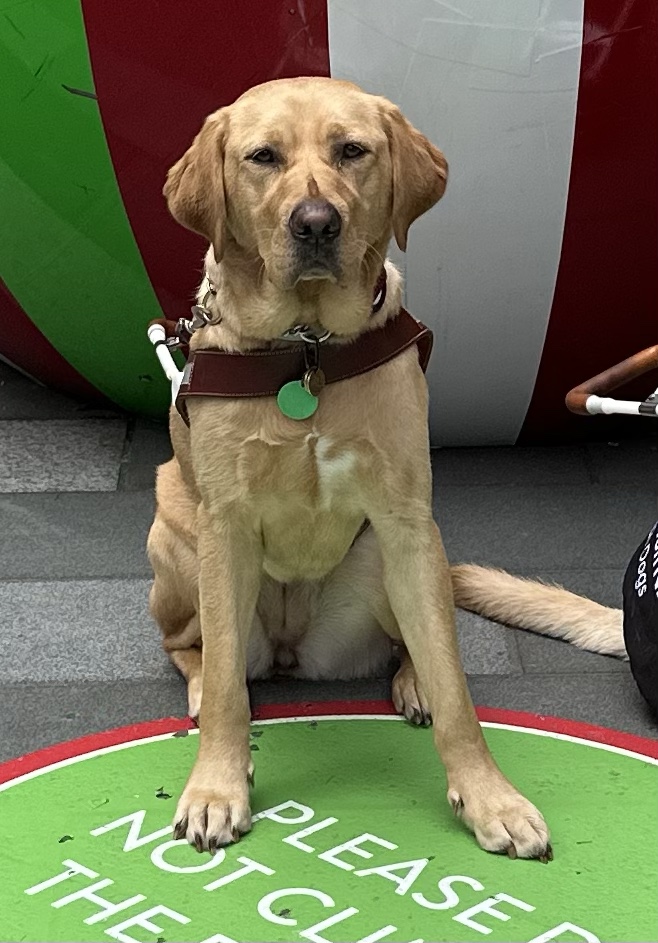
Earlier this week, I walked with my Guide Dog, Sienna, into our staff room at work. I saw two people about a metre, maybe two away, that I didn’t recognise but wanted to sit next to them. I couldn’t hear them talking as there was chatter from people behind me. I approached the sofa with my coffee and asked, “do you mind if I sit here, you aren’t afraid of dogs?”
There was silence. No one answered. I am even unsure if they heard me speak. Someone behind me said Sally sit down they are OK.
What I then realised a few minutes later was that the people on the sofa were colleagues I had known for many years and considered friends. Earlier I had spoken to someone else in that spot and identified others at the same distance perfectly.
This reminded me of the many influencing factors to how I recognise people. Firstly it is primarily by their voice. Suppose that isn’t possible, several other factors, height, hair colour, clothing style and colour are available. On further reflection, I do ask people “is that …” if they walk by fast talking and I am unable to see them.
In this instance, one of my colleagues was wearing her hair up, which she rarely does at work and wearing a clothing colour and style I had never seen her wear before. The other colleague I hadn’t seen for a while and had a haircut.
I was also reminded just how changeable my vision is over a day and consider the pathophysiology that causes this. I have normal tension glaucoma and need an eye pressure below 16 mmHg to slow optic nerve death and a pressure of at least 7 mmhg for my eye to maintain its shape (there are other conditions and considerations which make this higher than the usual 5 or 6 mmhg for others. During any one day, my pressure is between 4 and 14 mmHg. Lately, I have noticed more variability and have symptoms of pressure below optimum far more often than not. The pressure is a delicate balance and any treatment to raise my pressure runs the risk of causing more harm than good in the long term.
The most noticeable symptom is blurred and distorted vision that changes with the pressure over a day. It means that my prescription glasses may be perfect one moment and make my vision worse later. As a result, I think I keep my bank balance near zero and my optician in business. The variability has become too frequent to warrant continually changing glasses.
Many believe blindness means total blindness or is consistent for all people all the time. I had forgotten the extent of the changeability and impact this had until I didn’t recognise my friends in the staff room.
What I have noticed since I got Guide Dog Sienna 9 months ago is that this is a trigger for most of the occupational therapy staff with offices near me to state who it is when they approach, for which I am becoming more and more grateful as time goes on. Often it is “hi sally it is …” The next step in this journey is for me to become more accepting of this need and comfortable to ask people who they are without feeling I am interrupting them or being a burden.
The other timely reminder for me is that constantly changing vision over a day causes such as increased cognitive load and fatigue. With this in mind, my lesson is to be more forgiving and less hard on myself if I am not able to continue with vision-heavy tasks at that time and those around me can continue or I can’t finish things in the same timeframe as my colleagues.
I hope what I have shared here can assist others in some way.
Since becoming a guide dog handler, one of the things that comes with it is more public wanting to interact. However, not with me with my Guide Dog Sienna.
This post will give examples of recent interactions we have had with the public while Guide Dog Sienna was working in a 45-minute timeframe at a shopping mall.
The environment and previous or planned activities need to be considered while we are working as a team. However, any unexpected distractions can cause knock-on effects that may compromise our safety.
I have found that people are inherently curious about Guide Dog Sienna and often want to interact with her. What I find interesting is that often they do not interact with me or are disinterested in subjects that do not relate to Sienna. Most of the time, I encourage curiosity and take every opportunity possible to educate those around me about access needs.
For example, when I asked someone to stop patting Sienna while she was actively guiding me and needed to concentrate. The person replied, “but she is just too cute and I wanted to pat her”. What this person and some others don’t seem to understand fully is that the dog is there for their handler, not for them. Their purpose and job are to detect dangerous situations or obstacles and ensure their handler is safe.
Earlier this week, Guide Dog Siena and I were at Sylvia Park Mall with a friend. We had had a long day already and stopped in very briefly for one thing and were actively limiting the time we spent there to around 45 minutes maximum.
As context, we were both woken to the earthquake and Te Aroha at 0330 and with the poor weather (rain and high wind), Sienna was not concentrating as well as she usually does. She was very excitable, wanted to play more than usual at home and when we were out, was very distracted and needed extra time and encouragement. For me this means that I need to concentrate more, it also means that she is more likely to interact with the environment around us which could ultimately be unsafe.
I am working – my harness is on.
Our first interaction was with a shop assistant, who got visibly excited to see a dog, kept circling us, not interacting with my friend or me and reached out to pat Sienna. Sienna responded by wagging her tail and watching the shop assistant. I was lucky she was doing this in the small section of vision I have and I could therefore intervene. I asked her not to interact as Siena was working and needed to concentrate. She went completely silent and backed away and left before I could talk with her more and another shop assistant came and asked me if she could help.
The interaction in the shop caused Sienna to be even more distracted by her environment and she kept turning to face the door. As a result, I needed to concentrate on her rather than the task I was there to do. This was made more difficult by large cardboard boxes being unpacked on the shop floor, my need to move around these and Guide Dig Sienna trying to lead me to the door to leave (her reaction when she has had enough shopping). The extra cognitive load and responses to the environment for both of us prolonged our time there.
The second interaction was at the cafe. My friend went to the bathroom and I ordered. I asked the server about the menu and she kept pointing at the overhead sign and asked if I could just read it over there even after I had explained the reason I was asking was that I could not read it. I had Sienna sitting between me and the counter while I ordered. I then asked about cold drinks and she pointed to a small printed sign saying just read this. I explained again I could not read it and asked if she had flavoured tea. The queue behind us was growing and the assistant looked stressed, so I asked for a soft drink that I knew would be available (but didn’t want) and turned to find a table to wait for my friend.
I asked Sienna to turn around and find a seat. She was about to start doing this when a woman caught my arm, which distracted her from this task and meant she was left without me following through on an instruction to her and had to stop and talk with this person.
The person who caught my arm said if you need some help, I can help. I know exactly what it is like. I have had keratoconus. I thanked her and explained I was okay and had ordered. She then repeated what she had said, expanding on her story about her keratoconus experience. While her words were genuine, I understood she wanted to talk about her experience. I acknowledged how hard that must have been for her and explained I needed to go.
At the next table, there was a large family, two adults and four or five children. The two youngest children kept leaving their table and trying to get to Sienna. Their parents managed the other children and actively worked to keep the younger two away. Although this was distracting for Sienna, I appreciated that they understood Sienna was working and explained this to their children.
On our way back to the car, we were stopped by a woman while we were walking (quite fast). She didn’t interact with Sienna but talked with me (a nice change). She explained that she volunteered at the Guide Dog Kennels and wanted to know Sienna’s name as many dogs she cared for do not go on to work.
In my experience, most people know not to interact with their Guide Dog while working. However, what seems unclear to many is what working means. Is it only while they are walking? The short answer I use is when she’s wearing her harness. If a child pets Sienna without asking or makes a fuss to their parent about wanting to pat the dog, I use this as education and I often show them how the harness comes off and that they can pat her when it is off but not on.
This was not the most convenient mid-stride, but a breath of fresh air as most people assumed I was training Sienna and when I explained she is my guide dog and fully trained, they either seemed to be less interested or said, “but you don’t look blind”. I will leave unpacking this for another time.
The subsequent encounter was the real issue. While I was having a conversation with the volunteer from the kennels, another stranger walked up briskly and started patting and fussing over Sienna, who was sitting, waiting perfectly for us to finish talking. I said to the woman, “excuse me, please don’t pat her. She is working”, and she seemed taken aback by this request and said something like “but, I like dogs”, and left us to finish our conversation. Sienna was getting increasingly distracted each time a person stopped me or interacted with her and I could tell she just wanted to leave the mall.
I finished the conversation with the volunteer and directed Sienna toward my friend’s car. Sienna was extraordinarily distracted and as a result, walked herself and me straight into a big metal 1.5 meter sign (video signage). We were both unhurt but if this had happened about 10 metres away we would have been in the busy carpark which is even more dangerous.
What I have learned is that many people do not actually understand what working means for a guide dog. Some believe it is when they are walking along or actively guiding but it is more than that it is when they are wearing their harness. For this reason, I do not allow others to pat her while in harness. I know some handlers do let people interact while in harness but the majority do not to make this delineation clear to both the dog and public.
As a result I plan to change my language and be more descriptive instead of just saying she is “working”.
The key message here is consider the consequences of your actions. Even though guide dogs are cute and well behaved and are in public places they have tasks to perform and any interaction or distraction of a guide dog could in turn cause harm.
Today the theme of cognitive load associated with low vision when interacting with the world continues. However, the focus has shifted from describing and questioning the problem to giving two simple real-world examples where a slight change from motorists could make a big difference to someone with low vision.
Last week I posted a story to Facebook, which I will repeat here to set the scene.
I took Sienna to the park as I had recently been too unwell to walk her all the way to work as usual (and still am) and she was becoming a little naughty as a result. On the way back from the park, we encountered an obstacle. I did use the Snap. Solve. and Send. App (https://services.snapsendsolve.com/accounts/referral?code=5EU1-1-0) to report this.
An obstacle we encountered on the way home from the park.
Guide Dogs are trained to avoid obstacles and thus decrease the cognitive load and visual fatigue associated with navigation of the environment.
Guide Dog Sienna stopped to show me there was an obstacle. This one was challenging as not only was there long grass, a pole and uneven ground, but also a vehicle completely blocking the footpath.
On a day full of glare, I find that lately, if the glare comes from above, such as a grey or sunny sky, it completely blocks my ability to see the scene. Six months ago, I would have been able to see through the glare, so even navigating a situation like this increases the cognitive processing and cognitive load for both guide dog and handler.
One way I can get around an obstacle like this is to ask Guide Dog Sienna to “find the way” and she will find a way around. In this instance, she was hesitant because of the different hazards. Ultimately, we had to step out into the road to go around. The verge was another option, but the ground there is quite uneven. Going onto the road is hazardous in itself.
One aspect of being a Guide Dog Team is looking out for each other’s safety. I judge the traffic and know the route and Sienna avoids obstacles. Judging traffic with 5 degrees of usable vision and decreased hearing on the right is much more challenging than when I had 90 degrees and normal hearing. Situations like this now need far more cognitive and physical energy to navigate.
The energy consumption of navigating our community was something I may not have even noticed a year ago. However, this is often a challenge; what is hidden is the impact this can have on subsequent activities. For example, after navigating a busy shopping mall or area, I usually am tired, have a headache, have eye strain and am nauseous and typically change my plans to go home and rest.
Last weekend, Guide Dog Sienna and I visited a local market with her sister Guide Dog Sasha and her handler Michelle. After an hour at the market, Michelle and I were both fatigued from the business of the market and the number of dog distractions at the market.
Guide Dogs Sasha (left) and her sister Guide Dog Sienna while we were waiting for an Uber at the bus station after visitimg the market.
At the market, I noticed more than ten dogs we passed in the crowd. These were of varying breeds, demeanours and behaviours and both dogs found navigating these distractions challenging. In turn, this can be challenging for the handlers as we may not see other dogs or people, couple this with a crowd and needing to manage the guide distraction while navigating a challenging environment and everyday activities like this can become less frequent and less accessible to many.
Guide dogs are often distracted by other animals and people who reach down and pat them while they are in harness working. In their harness, guide dogs are vulnerable. They are trained not to react to situations many other dogs may respond to. In other words, they have little fight-and-flight reaction. This is a good trait as it makes them dependable in many situations, such as riding the bus or a plane, travelling on an escalator or crossing a road. However, other dogs and people are unpredictable and often, this relationship can distract the dog from guiding its handler, which requires intervention from the handler.
Getting back to the point. The right balance of activities is vital but often does not match societal expectations due to the hidden nature of processing and fatigue associated with navigating society a disability.
The reason this post migrated from Facebook to a blog post is what I found today. I went to get a coffee at a cafe around 1100 hrs as I needed a break from the screen at work.
While at the cafe, I had taken a work phone call which was challenging and when we started walking home, I was still concentrating on solutions related to that call. On our way back, we found the following obstacle.
More obstacles we encountered today.
In the above situation, we were lucky that Sienna could find a reasonably safe yet very suboptimal route. We ended up walking through a group of parked cars, employees and customers talking and uneven ground to get past.
The complexity of navigating situations like this back to back with vision-heavy work can be fatiguing and has reminded me to listen to my own body and accommodate in relation to this.
The point of this story is a little forethought from others (e.g. car parking and poorly behaved pet dogs) can have a significant impact on how a person who has a disability interacts with the world.
I hope this story has given others an insight into the challenges of navigating a world that isn’t designed or socially accepted as inclusive for those with disabilities.