Category: Reflection

  • I was reminded several times in the last week how our assumptions can influence and impact others. There are two examples of this I would like to discuss. The first was challenging my own beliefs when I went to a Christmas Concert featuring the Auckland Symphony Orchestra, among other performers. The second was the assumptions of others.

    At a Christmas Concert on the weekend, I found myself wearing sunglasses when I usually would not have needed to. It made me recall some assumptions I made as a child of around 13 years old. I typically associated a blind person as someone who could not see anything, wore boxy blacked-out glasses indoors, at night, and outdoors and needed to tap around a white cane and had to have help with “everything”. Over the years, I had learned that this assumption was not the norm. However, thoughts creep back in at times, and I need to remind myself that my assumptions are not necessarily generalisable. This experience caused me to reflect on why I was wearing sunglasses when I was wearing them and how much these helped me.
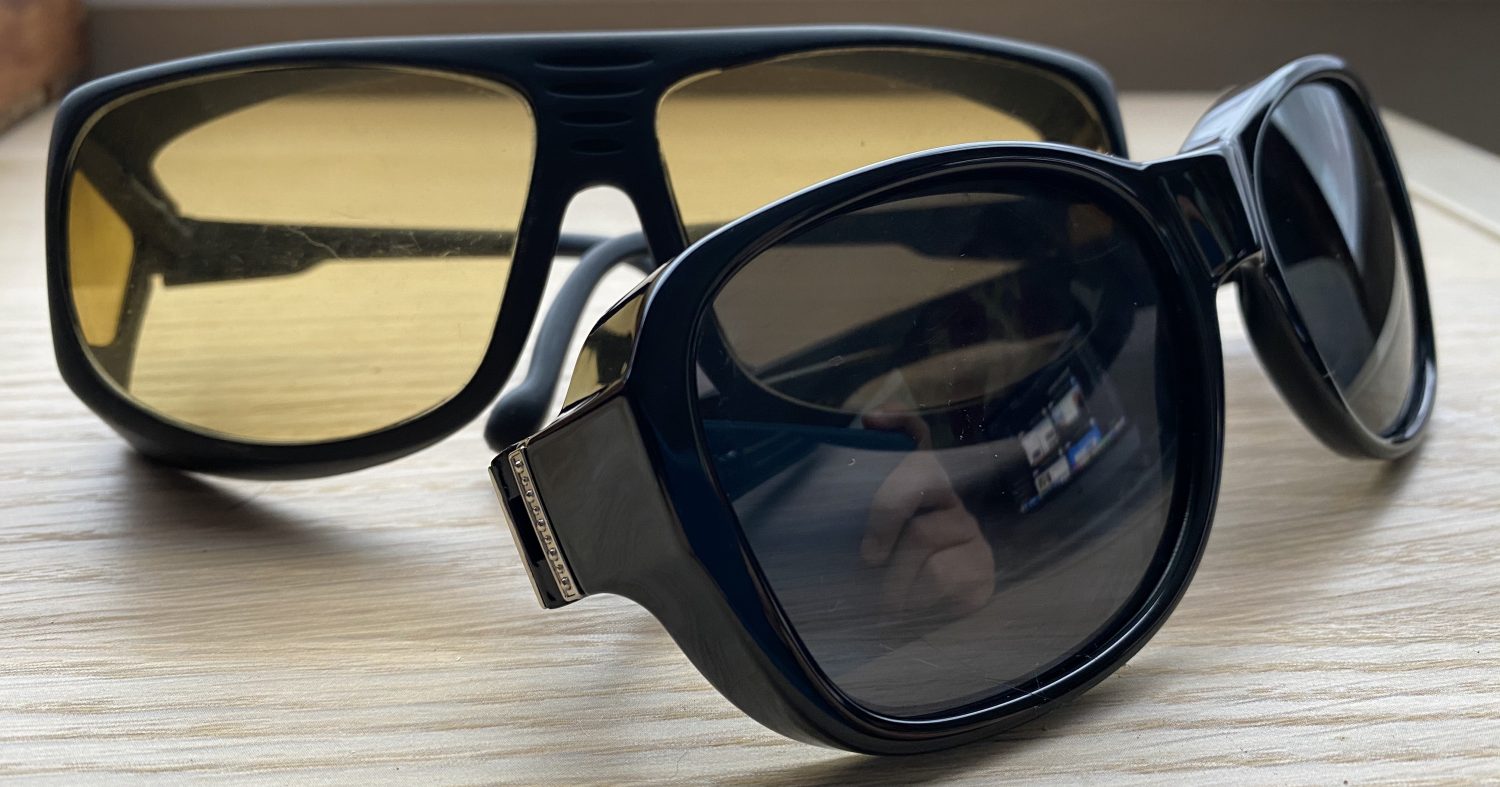
    Two pairs of my sunglasses.

    I realised that I was “just like” the assumption my 13-year-old self made, which was slightly confronting and made me consider how I wanted to be perceived: a confident, independent and well-rounded person who gets on with what she needs to do without bringing attention to herself.

    This led me to reflect on how I wanted to be perceived and why I was so afraid of being recognised as blind (or low vision) – or in a nutshell, as different. I concluded that this was because of societal perception of blindness as a deficit (as an aside, I am an academic struggling not to link this blog post with a theorist, model or research but continue it as an informative story of life). In true academic fashion, this led to more questions than answers, so I decided to present the beginning of my list:

    • Is low vision actually a bad thing?
    • Why is it often depicted in that manner?
    • Why do I often believe it is “bad”?
    • How much has society had to do with this assumption?
    • How and why did society come to those conclusions?
    • Why do I revert to believing these societal norms?

    I didn’t want to be known as the person with “low vision” or “can’t see” because this mindset is a deficit, where society seems to hold different standards.

    For now, I will park the theoretical component of these questions and explain how these concepts relate to my experiences. Over the last six months, in particular, I have noticed my visual field getting smaller and have not been seeing some things around me. Interestingly, I feel I have been conditioned not to let those around me know or help when I find things difficult and get on with things myself. For example, in a crowded meeting, today people got up and moved towards the door, leaving a wake of scattered chairs which I promptly fell over. My response was to get up and continue with my day and fly under the radar.

    A prime example of lower standards occurred when I walked to work on Friday (rubbish collection day). There are usually multiple wheelie bins on the footpath. While these make annoying obstacles (and I need my sunglasses even to see them), they are necessary for life in the community. As a response, I tend to use my cane more to determine how far away they are. During my walk, I was passed by a woman and smiled, saying good morning and kept on walking. About 20 metres down the road, she stopped me and said with conviction: “I think you are amazing”, going on to say, “I watched you get round those rubbish bins … you are just amazing”. I didn’t know how to respond and opted to say thank you and kept walking.

    This person had made a few assumptions in her statements, and I was left feeling that I was being judged for my low vision (I do acknowledge my assumption here). I thought about this for the rest of my walk to work, and it cemented how much assumptions prevalent in society can influence your own self-perception and, in turn, self-esteem. I want to think that I am amazing at contributing to the community rather than navigating around a rubbish bin. While I measure myself against my contributions to society as a person, academic, nurse, volunteering, project work and as a leader in my own right, it would appear based on assumptions others may have much lower standards.

    Tattoo with binary code that says "I am enough"

    This comes full circle to how I respond to these assumptions, in other words, what I can control and what I can not. I have concluded that all I can control is how I perceive myself and decide to promote myself to the world. I want to be honest and acknowledge that my response is that self-perception and esteem are impacted by societal assumptions. I often set myself very high expectations to counterbalance the deficit model described above.

    To remind me of the influence of society, I recently got a tattoo where I can carry a message to myself as a constant reminder. I will let the readers decode the tattoo, be aware that I have left the first four digits off of each row.

    ,
  • Today I would like to talk about the changing landscape both figuratively and literally.

    After finishing a long day at work today, I had three events to attend for professional organizations I support related to my job.

    Two of these were in the city. I do go to the city campus of my workplace at times. However, the campus and vicinity are familiar and I don’t generally venture far from it.

    Generally, I’m fairly confident navigating my way around, finding where I need to go, and getting there. However, today was a very different and confronting experience.

    It was the first time I had been to this particular area in the city for around 18 months. The landscape had completely changed.

    Over the last six months, my visual field has decreased significantly (you can read about this in my previous post). While I knew the area I was in, it was very unfamiliar. I had been there before it was when I had much better vision and in my mind, I expected that the experience of this area and the layout would be very similar to the last time.

    This expectation was far from the truth and my experience was considerably different. I knew where I needed to go but getting there was challenging and physically and emotionally exhausting.

    Imagine when you are tired, yet your environment continues to overstimulate you. You try to track everything around you to ensure you remain safe while navigating with one eye closed and looking through a cardboard tube with the other.

    One particularly frightened me was the addition of painted bike and scooter lanes (on the footpath). Where people and fast-moving vehicles darted unexpectedly to avoid each other. I tried to keep track of everything around me but found it so overstimulating and visually challenging that I just had to stop for a while before setting off again.

    To combat this, most of the time, I navigate my environment systematically, but today this approach did not work.

    I finally arrived where I was meeting friends and colleagues; I entered and walked the perimeter of the rooms to find my friends. I couldn’t see any of them. I did another circuit and decided to go outside and call, no answer; I texted and waited 15 minutes. It was cold and windy outside, so I decided to find somewhere warm, get a drink and wait for the next function to start.

    It struck me just how isolating restricted vision can be – particularly when technology can’t help. What began as an easy adventure had become challenging because of the changes in my vision.

    Photo by Pixabay on Pexels.com

    I eventually did manage to meet my friends, they were sitting in one of the rooms, but I did not see them despite walking past. I couldn’t express just how fatigued I was getting there and cried when I found them.

    What this has reminded me of three things. Firstly, the need to conserve the use of my vision. Secondly, my expectations and ability to thrive in busy, crowded and unfamiliar environments might need to change. Lastly, that these changes aren’t a failure but a new beginning.


    , ,
  • After two weeks in lockdown to prevent the spread of COVID-19, I have left my home a total of three times.

    Once to pick up a prescription and once to buy vegetables and once to go for a walk. In these times, I have come closer than 2m to three people outside of my isolation “bubble”, and in all cases, they were wearing some form of PPE.

    While the isolation process is a change to the life I have become used to, there are positive aspects; for example, I can work from home for the most part. My work has been less interrupted and, at times, more productive. At home, there is also less traffic noise at night which means getting to sleep is easier.

    Socially we have adapted. We now have virtual coffee, virtual drinks and today, a virtual afternoon tea for a staff member leaving. A further example of adaptation is related to grocery shopping. Instead of more frequent visits to the supermarket, I find myself waiting up until midnight to get delivery slots for groceries instead of same-day orders and delivery before lockdown. Even though ordering over a week in advance is a new thing, it is not a big problem.

    Overall, I would consider myself pretty resilient, a problem solver and someone who strives to make the best of most situations. Logistically, isolation has not been as hard as I expected it to be. However, I did underestimate the emotional toll of loneliness, uncertainty, fear and loss of family contact.

    Photo by Markus Spiske on Pexels.com

    My isolation bubble is small and consists of myself and a flatmate. My family have two other bubbles in NZ. The first is my mother and brother (who also have the same genetic respiratory condition). The second is my father, who is in a bubble of his own with Hospice staff.

    Today my morals were challenged. The hospice doctor discussed that I could visit my father in his last hours soon. Currently, the COVID-19 lockdown means no visitors other than compassion at the end of life.

    While it will be fantastic to spend time with Dad, the context is not the best. Over the last few weeks, I have found not seeing him or helping with his care very challenging, but this is with the knowledge that I could cause harm to others by breaking the rules.

    The dilemma I face is the safety of others versus my own and my father’s desire. Just how many bubbles do I burst to spend time with him versus the risk of harm?

    Having low vision means that I can not drive. There are usually other means for travel, such as rideshare, taxi, busses, friends, and more, but in lockdown, options are more limited by availability, cost, and time.

    There are a lot of things to weigh up. I really would like to see my father, just as he would like to spend time with me. However, other factors are in play, such as cost, time, emotions, lockdown, the potential spread of disease, and putting others at risk.

    As a nurse, and personally, helping others is important, this includes my father and the others I may encounter. In a lockdown, helping myself and my father means not assisting others. In other words, both options are mutually exclusive.

    My father is in a hospice that is 35 minutes drive from my house. It would take me 3 to 4 busses and at least 1 hour 35 minutes weekdays. In taking this travel option, I would potentially burst at least 5 bubbles (not including other passengers). Taxi companies have quoted around $220 for a 35 minute trip with three bubbles burst (mine, the driver, my father).

    Asking my brother to take me is an option; however, his car has no warrant and registration. The local testing station is only open for essential vehicles making this a less viable option. While there may be compassionate grounds around the warrant and registration, this is a risk my brother is not willing to take. It would also burst three bubbles.

    Typically, organisations such as Hospice, Cancer Foundation and Blind and Low Vision may have volunteer drivers for visits like this. However, in lockdown, these options are not available.

    What I have come to realise is that no matter what option I take here, there is a cost, whether it be timing (e.g. the time it takes me to get to hospice to see Dad in his last hours), financial (the price of a taxi), emotional (not seeing Dad or putting others at risk) or risking spreading COVID-19, travelling outside of my local area (breaking the law).

    Writing this post has reminded me that one of my personal and professional values is showing compassion for those around me and myself when we are all challenged by the world we live in.