I am privileged to span the divide between clinical healthcare, academia and the growing digital world and I often find myself translating meaning in any one of these environments for those who work in another. To give you context, these are the groups I identify with:
- Healthcare – ED Nurse / former EMT, Practice Nurse, public sector Clinical Nurse Specialist, a paediatric nurse and consumer of healthcare.
- Education – Lecturer, Clinical Standards Tutor, online education developer and consumer/student (PhD).
- Digital – User, software developer, database admin, online education designer, PhD Candidate, *nix user (with the numberplate LNXCHK) and geek.
Today I was able to combine all of these skills to begin solving a health problem at the 2018 “Developers on FHIR” Challenge. Where the skills of developers and clinicians combined to work together on a health solution. In this case, interoperability using HL7 – FHIR framework to provide a solution in managing adverse events in healthcare.
This opportunity was exciting as it allowed me to make links between my previous clinical roles, past research (reducing error and cognitive load associated with weight estimation during paediatric resuscitation), current PhD (mobile application development for paediatric resuscitation) and position as an educator of future nurses. While these roles share common goals which relate to adverse events each has their own management solutions which highlighted the amount of siloed information and processes we navigate in our health journey. If this data were shared, with more streamlined interoperability it is highly likely patient outcomes and experience would improve.
Our team met in person for the first time at 0900 this morning after a brief email conversation. A small amount of preparation, an APP framework, a little background research and beginning of the final presentation/pitch were completed, but there was still a lot of work to do.
What struck me, to begin with, was the diversity of our team, for example, a strong “coder” / masters IT student, an IT lecturer / PhD Student, an IT Tutorial Assistant and myself who all had different strengths, backgrounds and personalities and had never met in person before.
The second thing that struck me about this experience was the passion and words of wisdom from the mentor team from HL7 at this event (Peter Jordan, Martin Entwistle and David Hay).
Interestingly, until now, I had always felt like a bit of an outcast in the clinical world and software development world as I did not entirely belong in either. Today, I entered this event thinking I had limited experience in software development and would not contribute much. However, I found that, as a clinician, I could offer knowledge of the environment, processes, as a patient and a consumer point of view and as a developer an understanding of data storage, transmission and app development. What turned out to be the most important contribution was a combination of all of these skills and the ability articulate both clinical and software development perspectives within our team.
Overall, I have learned a lot today, predominantly that we need to work together up front to succeed. This means, clinical and digital teams who manage health data need a standard language/interface which is where I believe FHIR is essential.
You are probably wondering what we developed/prototyped? A mobile APP called “Ad Rec” for adverse event reporting where, patients, treating clinicians, general practice staff and external agencies all contribute to adverse event reporting using common data structures and sources while with built-in reporting to external auditors such as governmental organisation. Where future research could evolve:
- Standardising adverse event classification.
- Simplify user APP user interface.
- Implementation of reporting such as direct reporting to MEDSAFE or CARM.
- Integrating different terminology such as patient versus clinician versus analyst needs.
- Push notifications for clinicians.
Here is a photo of our team at the end of the day after winners were announced.
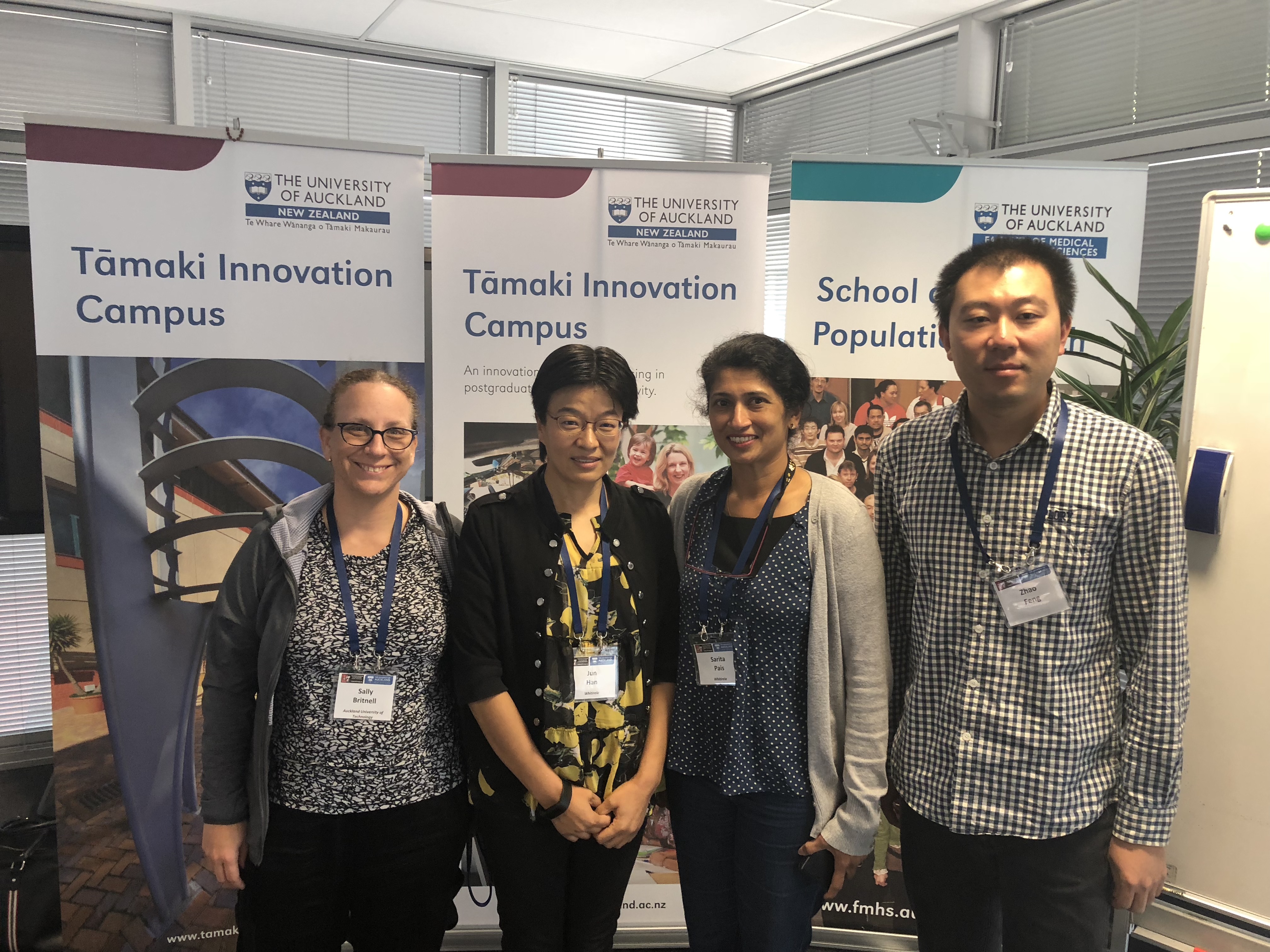 Photo previously published on Facebook with permission of those photographed.
From left Sally Britnell (RN, Lecturer and PhD Candidate at AUT / Auckland University of Technology), Jun Han (IT tutorial assistant at Whitireia New Zealand), Sarita Pais (PhD Candidate at AUT / Auckland University of Technology and IT Lecturer at Whitireia New Zealand) and Feng (Thom) Zhao (IT student at Whitireia New Zealand).
BTW – our project won.