This week I was reminded just how changeable my vision is in a day. I will tell a story to illustrate.
One of the catchphrases in the blind community is that blindness is a spectrum, which is accurate. What is usually even more unexpected is the changeability in that spectrum on any one day. I had sometimes forget myself.
Earlier this week, I walked with my Guide Dog, Sienna, into our staff room at work. I saw two people about a metre, maybe two away, that I didn’t recognise but wanted to sit next to them. I couldn’t hear them talking as there was chatter from people behind me. I approached the sofa with my coffee and asked, “do you mind if I sit here, you aren’t afraid of dogs?”
There was silence. No one answered. I am even unsure if they heard me speak. Someone behind me said Sally sit down they are OK.
What I then realised a few minutes later was that the people on the sofa were colleagues I had known for many years and considered friends. Earlier I had spoken to someone else in that spot and identified others at the same distance perfectly.
This reminded me of the many influencing factors to how I recognise people. Firstly it is primarily by their voice. Suppose that isn’t possible, several other factors, height, hair colour, clothing style and colour are available. On further reflection, I do ask people “is that …” if they walk by fast talking and I am unable to see them.
In this instance, one of my colleagues was wearing her hair up, which she rarely does at work and wearing a clothing colour and style I had never seen her wear before. The other colleague I hadn’t seen for a while and had a haircut.
I was also reminded just how changeable my vision is over a day and consider the pathophysiology that causes this. I have normal tension glaucoma and need an eye pressure below 16 mmHg to slow optic nerve death and a pressure of at least 7 mmhg for my eye to maintain its shape (there are other conditions and considerations which make this higher than the usual 5 or 6 mmhg for others. During any one day, my pressure is between 4 and 14 mmHg. Lately, I have noticed more variability and have symptoms of pressure below optimum far more often than not. The pressure is a delicate balance and any treatment to raise my pressure runs the risk of causing more harm than good in the long term.
The most noticeable symptom is blurred and distorted vision that changes with the pressure over a day. It means that my prescription glasses may be perfect one moment and make my vision worse later. As a result, I think I keep my bank balance near zero and my optician in business. The variability has become too frequent to warrant continually changing glasses.
Many believe blindness means total blindness or is consistent for all people all the time. I had forgotten the extent of the changeability and impact this had until I didn’t recognise my friends in the staff room.
What I have noticed since I got Guide Dog Sienna 9 months ago is that this is a trigger for most of the occupational therapy staff with offices near me to state who it is when they approach, for which I am becoming more and more grateful as time goes on. Often it is “hi sally it is …” The next step in this journey is for me to become more accepting of this need and comfortable to ask people who they are without feeling I am interrupting them or being a burden.
The other timely reminder for me is that constantly changing vision over a day causes such as increased cognitive load and fatigue. With this in mind, my lesson is to be more forgiving and less hard on myself if I am not able to continue with vision-heavy tasks at that time and those around me can continue or I can’t finish things in the same timeframe as my colleagues.
I hope what I have shared here can assist others in some way.
Today the theme of cognitive load associated with low vision when interacting with the world continues. However, the focus has shifted from describing and questioning the problem to giving two simple real-world examples where a slight change from motorists could make a big difference to someone with low vision.
Last week I posted a story to Facebook, which I will repeat here to set the scene.
I took Sienna to the park as I had recently been too unwell to walk her all the way to work as usual (and still am) and she was becoming a little naughty as a result. On the way back from the park, we encountered an obstacle. I did use the Snap. Solve. and Send. App (https://services.snapsendsolve.com/accounts/referral?code=5EU1-1-0) to report this.
An obstacle we encountered on the way home from the park.
Guide Dogs are trained to avoid obstacles and thus decrease the cognitive load and visual fatigue associated with navigation of the environment.
Guide Dog Sienna stopped to show me there was an obstacle. This one was challenging as not only was there long grass, a pole and uneven ground, but also a vehicle completely blocking the footpath.
On a day full of glare, I find that lately, if the glare comes from above, such as a grey or sunny sky, it completely blocks my ability to see the scene. Six months ago, I would have been able to see through the glare, so even navigating a situation like this increases the cognitive processing and cognitive load for both guide dog and handler.
One way I can get around an obstacle like this is to ask Guide Dog Sienna to “find the way” and she will find a way around. In this instance, she was hesitant because of the different hazards. Ultimately, we had to step out into the road to go around. The verge was another option, but the ground there is quite uneven. Going onto the road is hazardous in itself.
One aspect of being a Guide Dog Team is looking out for each other’s safety. I judge the traffic and know the route and Sienna avoids obstacles. Judging traffic with 5 degrees of usable vision and decreased hearing on the right is much more challenging than when I had 90 degrees and normal hearing. Situations like this now need far more cognitive and physical energy to navigate.
The energy consumption of navigating our community was something I may not have even noticed a year ago. However, this is often a challenge; what is hidden is the impact this can have on subsequent activities. For example, after navigating a busy shopping mall or area, I usually am tired, have a headache, have eye strain and am nauseous and typically change my plans to go home and rest.
Last weekend, Guide Dog Sienna and I visited a local market with her sister Guide Dog Sasha and her handler Michelle. After an hour at the market, Michelle and I were both fatigued from the business of the market and the number of dog distractions at the market.
Guide Dogs Sasha (left) and her sister Guide Dog Sienna while we were waiting for an Uber at the bus station after visitimg the market.
At the market, I noticed more than ten dogs we passed in the crowd. These were of varying breeds, demeanours and behaviours and both dogs found navigating these distractions challenging. In turn, this can be challenging for the handlers as we may not see other dogs or people, couple this with a crowd and needing to manage the guide distraction while navigating a challenging environment and everyday activities like this can become less frequent and less accessible to many.
Guide dogs are often distracted by other animals and people who reach down and pat them while they are in harness working. In their harness, guide dogs are vulnerable. They are trained not to react to situations many other dogs may respond to. In other words, they have little fight-and-flight reaction. This is a good trait as it makes them dependable in many situations, such as riding the bus or a plane, travelling on an escalator or crossing a road. However, other dogs and people are unpredictable and often, this relationship can distract the dog from guiding its handler, which requires intervention from the handler.
Getting back to the point. The right balance of activities is vital but often does not match societal expectations due to the hidden nature of processing and fatigue associated with navigating society a disability.
The reason this post migrated from Facebook to a blog post is what I found today. I went to get a coffee at a cafe around 1100 hrs as I needed a break from the screen at work.
While at the cafe, I had taken a work phone call which was challenging and when we started walking home, I was still concentrating on solutions related to that call. On our way back, we found the following obstacle.
More obstacles we encountered today.
In the above situation, we were lucky that Sienna could find a reasonably safe yet very suboptimal route. We ended up walking through a group of parked cars, employees and customers talking and uneven ground to get past.
The complexity of navigating situations like this back to back with vision-heavy work can be fatiguing and has reminded me to listen to my own body and accommodate in relation to this.
The point of this story is a little forethought from others (e.g. car parking and poorly behaved pet dogs) can have a significant impact on how a person who has a disability interacts with the world.
I hope this story has given others an insight into the challenges of navigating a world that isn’t designed or socially accepted as inclusive for those with disabilities.
If I utter the words denial of service, half of those in my life will think my computer was hacked and the other half would link this with accessibility. These two varied meanings illustrate the differences in perception across our society and show the value of knowledge and education.
This post covers multiple interrelated concepts, so first, I will give a little background information about myself for context. All my life, I’ve been an incredibly outgoing person who would give anything a go, from waterskiing to scuba-diving to rock climbing, skiing and many other non-team sports—going out with friends, travelling internationally and working on very demanding jobs. This was with around half of the vision that sighted people have.
I also revelled in proving the career advice at high school very wrong. I was advised to find a job as a secretary and that being a nurse and attending university was not attainable, mainly as my eyesight made me read extremely slowly.
In response, I went to live in another country, returning and entering university as an adult and later becoming a nurse and gaining a PhD in an Engineering, Computing and Mathematics School. I tell the story to give you an example of my tenacity to point out when I raise challenges, difficulty, defeat, fatigue or other associated things this isn’t said lightly.
There have been ups and downs with my vision over the years, one of which was having my retina reattached on my 21 st birthday for the third time. Throughout, I have managed to continue in jobs that I love, progress in my career, meet interesting people and live a fantastic life. I Achieved this by working Hard not to let people notice that I had In issues with my vision, and when it became a problem, work harder to make it less visible (in hindsight, perhaps not the best approach, but it was what society accepted at the time).
There was a point in time I had to change in 2019. I lost half of my remaining vision, leaving a quarter of the field of someone with an average field. Recently I have learned that we have about 5 degrees left (of 155-180 degrees) and we have exhausted all treatments available. In a nutshell, there is no more medicine and science can do to stop or slow deterioration.
Guide Dog Sienna arrived when we began the first three tests to confirm progression and that treatment wasn’t working. While this was amidst our training together and the news and training were incredibly fatiguing, the companionship, joy, freedom and responsibility this bought was unbelievable.
Guide a dog Sienna and I was having lunch in a friend’s office last week to celebrate his birthday. This photo shows the companionship we have when Sienna is out of the harness.
To give you an idea, I had not gone out for entertainment or leisure alone (without a friend) for about five years. I hadn’t realised that my world had become so small and that I was saying no to more outings with friends because they were challenging visually. With Guide Dog Sienna since May, I have been to a play, a movie, a tour of my favourite craft shop in Mt Wellington and many other places I would have usually avoided. Last week, one of my colleagues said you are so outgoing and do so much now, although they didn’t know me 5-10 years ago as a comparison.
On today’s adventure, I wanted to go to a different shopping centre to pick up something my local didn’t have. To achieve this, we went to a different bus stop on a different route. When we arrived, we checked to see how far away the bus we needed was only to find it cancelled and the next 45 minutes away. I had also booked an appointment, so 45 minutes plus a 30-minute bus ride for what would take 10 minutes in a car wasn’t going to get me there on time.
I looked on the taxi app and found a 30-minute estimated weight which was also cutting it fine. So switched to Uber. The closest Uber was 4 minutes away. The cost wasn’t too bad, so I booked.
I messaged the driver to say I was travelling with my guide dog and could they push the passenger seat in so she could sit in the footwell. I also ask them to yell out when they arrive as I can not read the number plate. This message has served me well with no issues in the past.
I got a reply from the driver about two minutes later asking me to cancel and rebook my ride. I answered no; if I cancelled, I would be charged and he would be paid. I suggested he cancel instead.
He didn’t cancel and I could see the car in the app getting closer as it used GPS. I got a message from Uber saying your driver is arriving. A vehicle with the right colour and shape pulled up about 5m away with no movement or opening of the window or verbal communication. The car then sped off. At the same time, I got a message saying the driver had cancelled the ride.
This made me wonder if the driver came in o the site to press cancel while he was at the start of the trip, as I understand there is an option to say they couldn’t find the person. I would completely understand if the driver cancelled with a message that he had a phobia of dogs or severe allergy, but no communication, just cancellation, is poor.
The app automatically assigned another driver six minutes away. I sent the same message about the guide dog and heard nothing back, but the app had told me that the driver had read the message, so I assumed all was good. I got another text saying that the driver was approaching and I could see it on the app. A car the right colour and shape pulled into a nearby driveway (carpark entrance), paused and drove away. At the same time, I got a message saying the driver had cancelled the ride. I wondered if they had seen Guide Dog Sienna and I waiting and cancelled.
The app automatically assigned a third driver 8 minutes away. I sent my message and got a reply saying “got it” and saw it was read. This driver did arrive, called out and moved the seat forward so Sienna could sit in the footwell. He provided fantastic service. Unfortunately I missed my appointment due to drivers cancelling and the appointment had both late and cancellation fees which is super frustrating.
I am left wondering why the first two drivers cancelled and drove away and suspect it was the Guide Dog. Guide Dog Sienna is highly trained before she became my guide and behaves beautifully in public transport, taxi and ride-share. Legally we can not be denied service based on the basis of her being a dog in these circumstances.
I want to raise awareness of these rules and regulations in New Zealand for those who are not aware.
I did send Uber a message hoping they could provide drivers with education around service animals and communication. I was impressed that my message to Uber help was answered with a phone call in less than an hour. The support person reassured me that their staff do have online training about service dogs and that the two drivers would be asked to complete this again and have their app restricted until this was achieved. They also gave me the 0800 phone number of the accessibility support team should this occur again.
The crux is that even though I missed out on an appointment and paid cancellation fees, the positive experiences and changes having a Guide Dog brings far outweigh the experiences like this.
This experience has strengthened my goal of educating this around me about access needs.
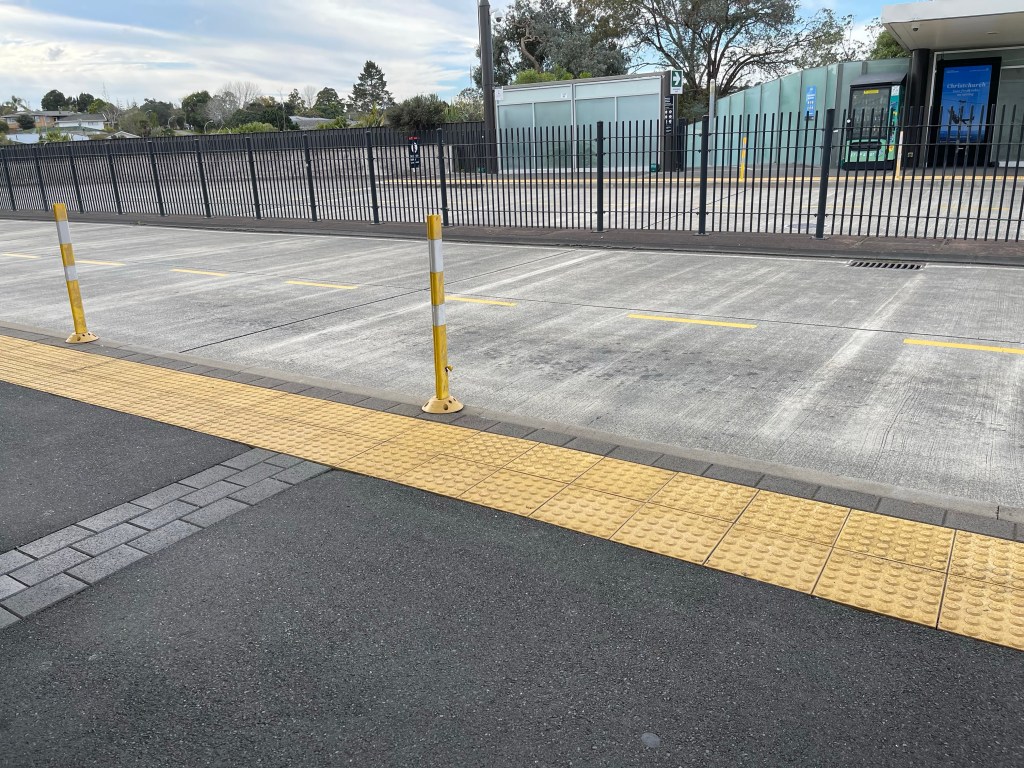
A mission for a separate day is related to educating bus drivers about needs – not just access requirements but considering everyone getting off a bus. The photo below shows the bus platform at a station near my house. I got off a bus here and the bus driver stopped so that one of the poles on the side of the platform was directly in the middle of the door.
As people were getting in as I was getting off, Sienna was watching the people and went around the pole and as it was so thin, I walked straight into it. Had the bus driver pulled forward 1 to 2 metres, this would not have been an issue. As it was, the pole is an issue for anyone, not just Guide Dog Teams.
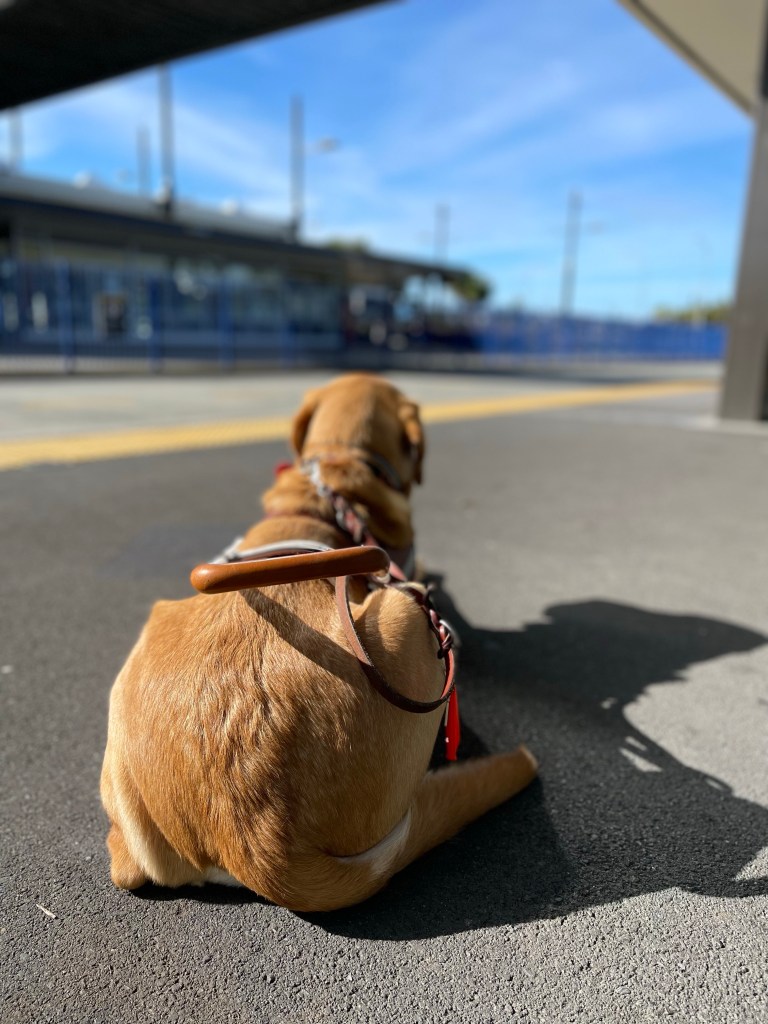
Local bus station with poles on the edge of the platform. Interestingly none of the other stations I have these blocking the way.This photo shows Sienna sitting at a different bus station waiting for a friend. Note no poles are blocking the platform!