Category: Uncategorized

  • Tonight I had a phone call at about 1630 hrs asking for assistance with teaching first aid for a group of young people at 1830.  If there was no one to help the night would be cancelled for around 80 young people.

    I agreed and took on a group of around 20 young people aged 13 – 18-years.  We looked at the basics of assessing an unconscious patient, which went well.  However, when it came to assessing a conscious patient, it became apparent much of the learning was rote learning of the process and knowledge of the what and why needed some work.

    While practical activities were going on I thought to myself, does rote learning actually still have a place in first aid teaching?  I then asked myself what would first aid education be like without rote learning?

    In first aid, learning by rote provides a person with a process to follow in an emergency, which is useful for remembering what to do stressful situations.  For example, for an unconscious patient, we use DRSABC or Danger, Response, Send for Help, Airway, Breathing, Circulation.

    I posed a question to the group, is rote learning a process good enough to apply to all situations?

    With this in mind, I asked students to work in pairs.  Number 1 is a first aider and number 2 the patient.  The patient was to think of something that is wrong with them, and the first aider asks questions to learn what is wrong.  As expected, the students predominantly used closed-ended questions and a rote-learned process which did not go beyond these.  We then discussed trust and using communication skills to collect information.

    I introduced the SAMPLE (Signs and Symptoms, Allergies, Medications, Past History, Last Meal, Events Prior) pneumonic with the rider that they need to find out as much as they can with as few questions as possible.  While doing this using all of their senses to gather information about a situation.  This also went very well with all of the cadets engaging, participating, using teamwork and respecting the needs of each other.  The information gathered was more rich and complete than in the initial exercise.   

    Therefore, in doing this exercise, we learned that there is a need rote learning (e.g. SAMPLE), but it is the way we use this and formulate questions and gather information is key.

    Another key piece of learning for me today was by way of a reminder that learning can be fun and educational.

    One of the younger children (11 years) who had been in the group being taught alongside my group came up as I was leaving.   He asked, are you coming to teach us again?  I replied that I would be happy to fill in if need be but I couldn’t be there every week.  I asked why he wanted to know and he replied that he would be old enough to be in the group I was teaching in two years and he thought that the teaching and learning the group I was with was both “work and fun”.

    This reminded me, not only, why I became a teacher for adults and children.  But what I value the most about my day job and volunteer job.  Adapting what I do to meet the needs of learners by providing education in a way that is meaningful for them.


  • Tonight I stepped in at the last minute to teach around 15 children aged eight to ten years.

    The subject was health and they had covered the basics like healthy eating and hygiene needs so we tackled our thoughts and feelings.

    I asked them if they wanted to work as a large group or two smaller ones and they wanted two smaller ones. We identified good and bad feelings and then I set them a task to script, design and act a play to teach their peers about good and bad feelings. How to put themselves in someone else’s shoes.

    We have some very strong minded children in the group along with a shy new person with limited english. Initially they split themselves into two groups with different ideas. One group got on with what they had to do, scripted, found roles for everyone in the group, made costumes out of butcher paper and worked as a team.

    The second group found it hard to agree on ideas and consider each other in this. I watched the group having trouble and offered suggestions however it was not working out.

    The three in the second group wanted to join the others who were working well together well. This group opted to disband. I agreed and they wanted me to get them something to do in the other group. Instead, I suggested they go and ask if there was a role they could have in the others play. Which two of the three did and were readily accepted by the others.

    The play and props they designed were impressive for the 90 minutes they had to achieve this. The play centered around bullying at school and every person had a role, even the shy person who only joined that evening.

    They learned not only about teamwork, inclusiveness, but also thoughts, feelings and how to manage these.

    What I learned was about challenging my own assumptions and stereotyping. The young people had unconsciously put the people who were biggest, loudest and that I felt had the most stereotypically bullying characteristics in the most vulnerable role of the person being bullied. This made me reconsider my own assumptions around this.

    I would like to thank this group of young people for being so inclusive of all others no matter their personality, age, gender and culture in this activity. They adapted and included others at the last minute readily and I believe that working together and displaying these qualities at age eight to ten is an amazing achievement.

  • I am privileged to teach both at a university and for children aged 6 – 18 years and I find that engaging with both of these groups allows me to advance my teaching for the other.  

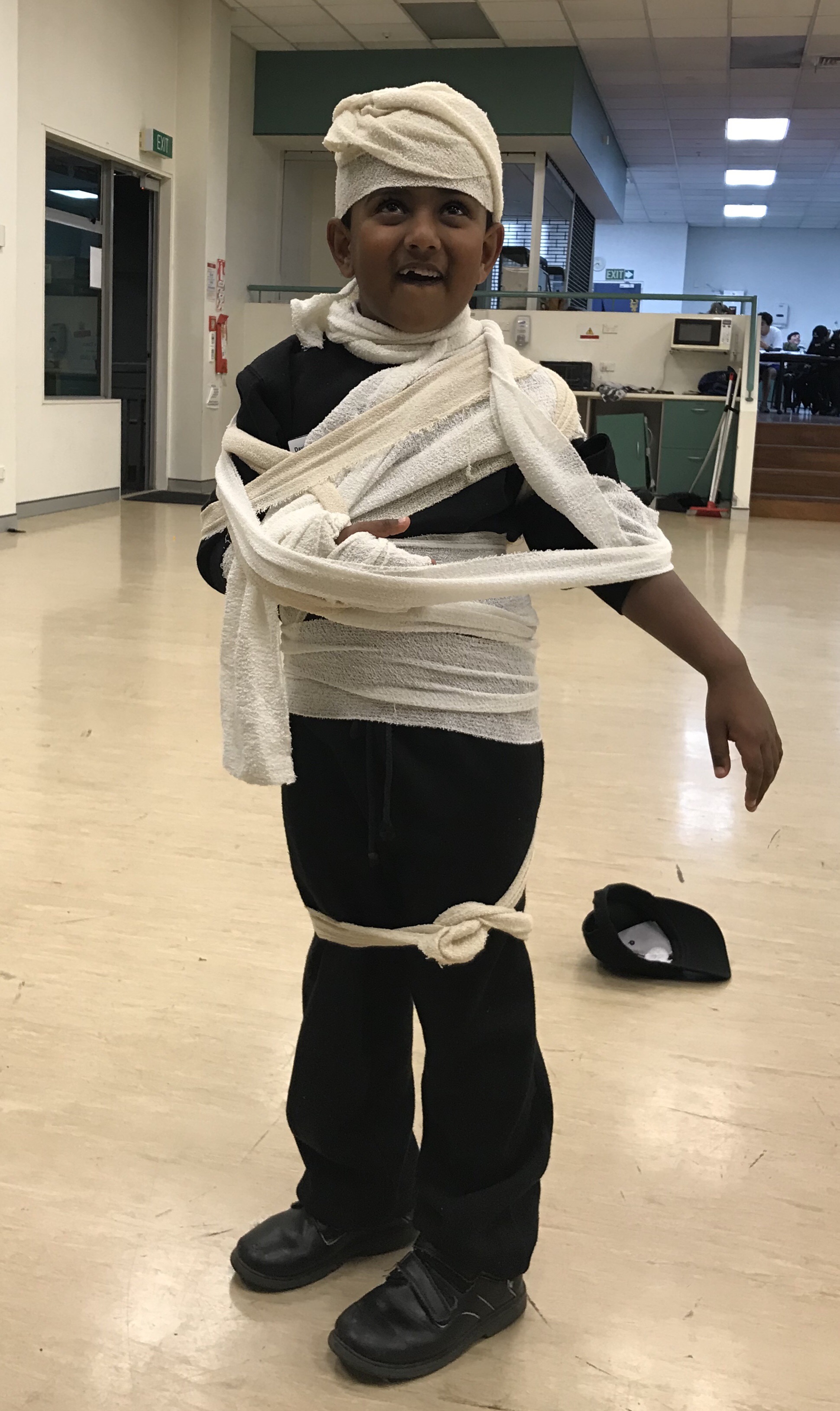
    A common thread for me is often a reminder of the experiential learning that we often take for granted.  For example – I was teaching a group of teenagers and overseeing the younger groups of children.  I remember looking up and immediately thinking – oh no the 6 year old’s are mucking around again, they can’t be learning.   The picture below is one of the things I saw:

    Permission was gained from this young man to use his photograph on social media.  

    At first I thought, “Oh no – they are mucking around” – this looks bad on my part as an adult / educator.  Minutes later, I remembered that there was a lot of hidden learning opportunities in this moment that I had briefly overlooked.  For example, bandages are stretchy, they feel rough which helps them to grip, you can tie them, roll them up and use them to stop bleeding.  For 6 year old children this is ample sensory / experiential learning.  Furthermore, you can make a “mummy” which is fun and assists with dexterity.  My job is to recognise and bring meaning to these moments which in turn allows a student to learn and grow.

    Application of this at a university level is more challenging and can be equally rewarding.  Society today is fast paced and teaching and learning is not offered in the same way it was when I was young.  This means that I now need to work with the unknown rather than the known / comfortable learning environment.  For me this has become a journey of research, learning and experimenting with guiding others learning to achieve the best outcome for them.

    Information is available 24/7 using technology and is at the fingertips of those learning, the balance between what students can learn, have learned or intend to learn is much more broad than when I was an undergraduate student.  I find that I rely on students self directed learning much more with the ease of access to information and it is easy to forget the diversity that our students bring.  This makes me question a few things:

    • Is our education environment conducive to individual education which takes into account life experience, prior learning and builds on this?
    • There seems to be a drive to offer the same learning experiences for all students, is this even possible?
    • How do we manage this balance between individual and collective education experiences? 

    These questions are not new and I seem to revisit them regularly, work hard on a path toward achieving these with current students only to find that the same learning environment does not suit the next students..  With one triumph comes a less successful moment and as one of my colleagues regularly reminds me the journey and learning we have from this is often just as important as the destination.  

    Today, again, my questions have no definitive answer.  This has reminded me that teachable moments are everywhere, in individual and collective situations.  These are valuable, recognising and acting on these is an important part of making a difference in education.

    .