Category: Vision

  • Most of my posts are sharing the difference working with a Guide Dog has made for me. Hands down, it has been amazing, positive and dare I say life-changing. However, I wanted to express that there can be less than optimal times too.

    When we work as a team, there is cohesiveness. We both read each other and work as one. If one of us isn’t at our best, sometimes the teamwork falters slightly.

    Today our day started as usual until we left the house. At the bottom of my stairs, we turn right to go to work and left to go to our local Cafe, which is one of Guide Dog Sienna’s favourite places as there are children to watch, other dogs to meet and potentially crumbs under the table that we sit at that I may not notice.

    I told Sienna to turn right at the bottom of the stairs. She stood and looked at me, then pulled left. I asked again and she looked at me, then pulled left and then on the third time, I used a deep no-nonsense voice that usually works and she sat and looked at me and looked left. As if to say no, mum, I don’t want to go to work.

    I decided to go left to get her moving and redirect her up the road toward work instead of down the road, which is usually going to our local Cafe. As soon as we turned left, Sienna had a spring in her step and almost cantered with her head held high until we turned right at the bottom of the driveway. She then slowed down and finally stopped moving after about 10 m. I knew she didn’t need to go to the bathroom as she had been earlier, so I coaxed her along.

    Sienna hadn’t done a go slow for quite some time but used to do it when we were going home and training as she wanted to stay out and about. We walked slowly. Instead of her usual level of concentration, she was distracted by many smells and sounds. She stopped sniffing the crossing poles and grass verge at any opportunity. The typical snap of her lead and low voice didn’t seem to work.

    Sienna trying to get my attention to play!

    Sienna is a young dog who turns two in September this year, so I was expecting her to be a little distractible, but this was much more than normal.

    Finally, I thought all was good until we were halfway across a road and she stopped, not moving forward. There were no dangers, so I told her to go forward again. She stood rooted to the spot. Because we were at a four-way intersection of a busy road, safety comes first, so I dropped the handle and asked her to heel to get off the road. No movement, so I ended up pulling her off the road with her lead (which has not happened since the beginning of our training).

    I wondered if something was wrong with her or if she was hurt. So I stopped on the opposite side of the road but couldn’t find anything. She followed basic commands like sitting and I couldn’t feel any injury. What perked her up was getting the treats out of my bag pocket and carrying them in my hand so she could see them as we walked. We got to the bus stop without incident.

    On the bus, Sienna usually responds well to the under command and sits under my seat by backing in. Today, she lunged head first under the seat (there may have been food) when I said under and proceeded to back out and sit beside me in the bus aisle. I physically moved her to under my seat, giving her praise for staying there for the rest of the trip.
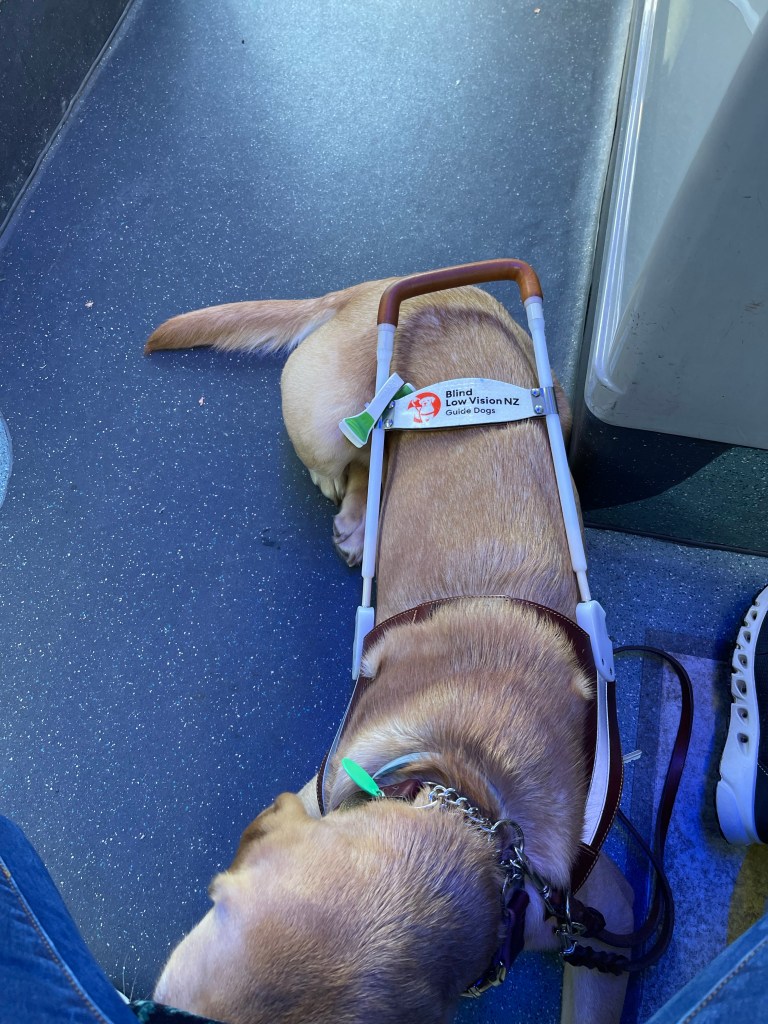
    An excellent under (sarcasm) aka sitting in the aisle of the bus. I moved her under the seat.

    We got off the bus as usual. However, Sienna didn’t take her typical path and was distracted, wagging her tail and wanting to interact with a student. I refocused her by using obedience and treats, asking her to go forward where she watched students and led me straight into an obstacle.

    At this point, we did some corrections and practice with her watching the object she didn’t avoid. I went and got coffee and headed to the office. I wonder if she had enough exercise, but we walk about 3 to 6 km a day, so she certainly does. I wondered yesterday if she was a little bored at work as she watched people go past and started to whine when one of her favourite people (Rachael) went past. Sienna certainly has toys, a bed and bones at work and we have breaks.
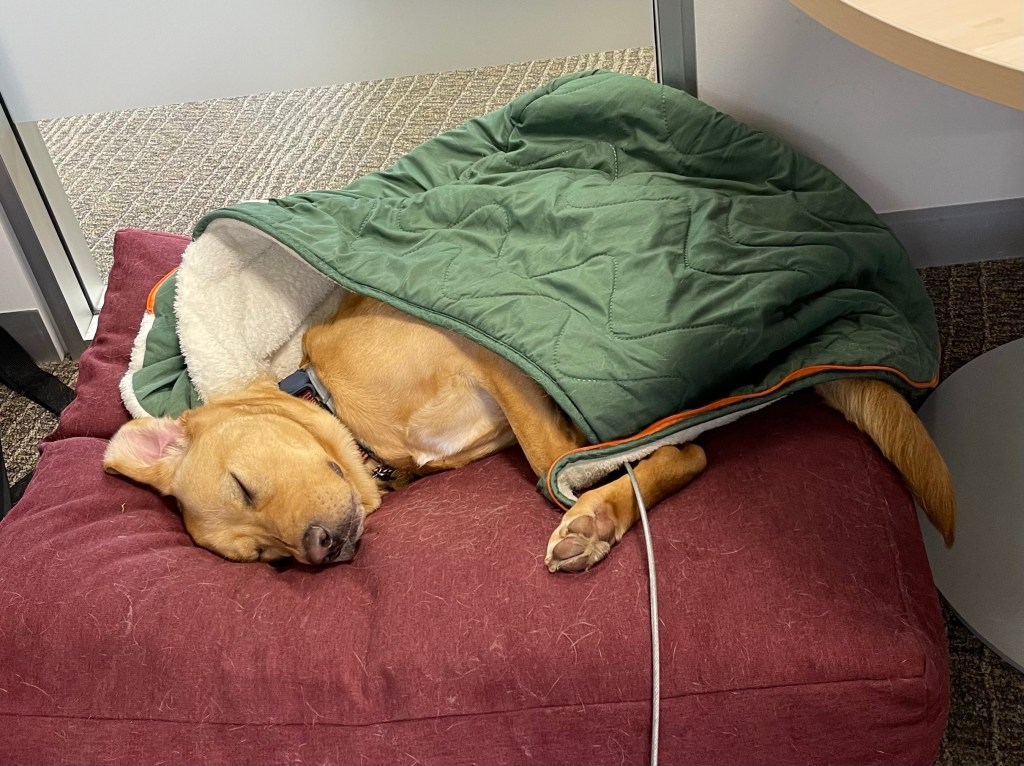
    Sienna chilling at work on the bed Sara made her under her 70s inspired dog sleeping bag.

    At about 1500 hrs today, Sienna was restless; she was trying to get my attention while I worked. Doing the perfect sit, vocalising and making dog noises picking up her toy and bringing it closer. I was ignoring her, so she barked. I have heard her bark five times (two of which were playing with other dogs she met at the beach). This isn’t the behaviour I want to reinforce at work, so I told her no and ignored her. She eventually settled and went back to bed.

    After 1600 hrs, she got restless again, which is semi-normal for her. If we don’t leave work by 1700 hrs, she seems very hungry and encourages me to leave work for the day. This is turning out to be q good thing as I had a propensity to keep working and go home about 2000 hrs. Now, if I know I need to stay late, I take her food to work, but this wasn’t a planned day to work late, so we needed to leave.

    For now, I am going to consider today a one-off and if she doesn’t settle call our instructor for advice. However, on reflection today I realised Sienna is not yet two so is still a puppy really. In saying that though, she does need manners when at work with me though.

    Sienna being a puppy at home playing with her turtle toy.

    My next Adventures of a Guide Dog Sienna will be more positive and focus on the positive changes from working with a Guide Dog that significantly outweigh our off days.

    , ,
  • Last week I was writing an abstract for a conference presentation that looked at the perceptions of accessibility in digital health from a consumer, clinician and developer perspective and it led me to reflect on assumptions and perspectives each sector brings.

    This reflection led me to think about the impact of how much we share or don’t share about the experience of disability. How much or what do others understand in designing of access needs.

    I have spent much of my recent years trying to look sighted, hide the fact that I had low vision and get on with things because I wanted to fit in. This raises a question, in choosing not to share this information, have I made it more difficult for myself later after losing more vision and becoming medically or legally blind?

    In society, we are conditioned to keep things to ourselves that may be difficult for others, are different or considered personal or might be a burden to others. In doing so, have I made it more difficult for others to understand why I may need some assistance or rest? Similarly, has my silence contributed to the societal perception of disability by omission or stopped others from learning about the lived experience of disability?

    With this in mind, I thought I would describe what I see (or don’t) and describe some of the impacts this has in everyday life, in particular the things that society and even the blind community often do not discuss.

    I will start with the clinical information. I have one sighted eye. In that eye, I have about 5 degrees of 150 to 180 degrees of vision remaining. While in optimal conditions, I see pretty well in that five degrees. It is considered low vision and my vision varies from day to day and is very dependent on the environment.

    When people often think of blind, they immediately imagine this as seeing nothing. In my experience, what I see is often more problematic and fatiguing than what I do not see. For example, in my 5 degrees of vision, what I see is very patchy. Some parts are clearer than others. I often see flashing lights, blind spots and blurred areas, which can move considerably with the pressure of my eye (usually, it is now low five mmHg or under – 12 – 20 mmHg is optimal).

    Food for thought.

    This means continual visual fatigue; what this is like for me is often experiencing visual overload, and my brain doesn’t keep up with filling in the gaps—holding my head at different angles to get the best vantage point and squinting to be able to see an object. The result is constant neck and back pain, headaches, fatigue and eye strain/pain. I have noticed more recently that if I do any visual activity on the weekend, it takes me time to recover and to work optimally during the week. This means reducing my usual fun activities on the weekends and resting. Picking and choosing what to do or attend to and listening to my body.

    For example, I booked a matinee play I wanted to see yesterday several months ago, but the amount of visual fatigue and workload at my job meant I slept through the time I was meant to be there. I was fortunate to get a ticket for the last showing but had to pay twice and use taxis instead of the bus, which quadrupled the original cost.

    Back to what I do see. In the upper left, there is swirling light, and if I look above the midline, a band of glare obstructs what I can usually see, causing discomfort. For this reason, I look at things from a different angle and wear sunglasses a lot more than many people do and have an office at work away from the windows with dimmed lights.

    My brain sifting through all of the abnormal visual activity is very distracting and fatiguing. I have had colleagues say how you are. I often reply fine or good because explaining visual fatigue is complex and challenging for people to imagine. I have said tired; the responses I have had are things like “you are always tired” or “yes, we are all tired”, so most of the time I don’t say the extent of fatigue or anything about it.

    Another quite disconcerting symptom is nausea. When around multiple moving objects, such as a crowd, I become nauseous from the visual distortion and movement. Having Guide Dog Sienna has helped enormously with this, as I can walk with my eyes shut in crowded areas to decrease nausea and increase my confidence when out and about. However, along with a guide dog comes barriers. For example, I was denied entry to places because I have a dog, such as certain Spotlight stores and my local Dairy. Uber drivers were cancelling the job because I have a dog, even though I put in the comments I have a guide dog that sits in the car footwell.

    Guide dogs are allowed into these places, shops, public transport, and rideshare; however, some people do not understand or know of this. They assume a dog is just a pet dog. I spend a lot of my free time educating others about access needs, equity and many other related concepts in a kind and compassionate way so that people may have a little insight into why I do things differently.

    This blog post and Guide Dog Sienna’s blog and Facebook page are freely available examples of this, alongside giving presentations, discussions, answering questions and encouraging others to ask.

    I guess what I would like to get across is that we are all learning to interact in an environment and have different values, beliefs and contexts, which all add to the narrative of any situation. It is these things that add richness to our human nature and lives.

    With this in mind, I am privileged to have worked in several different sectors, including clinician, educator, researcher, computer admin, software development and I am a consumer of these with access needs that offers a unique perspective.

    Back to how this blog post started submitting an abstract for a conference that covers digital, clinical, developer and consumer or lived experience perspectives combining technical, clinical and social constructs is unique and I am hoping that this will be accepted and am looking forward to presenting on a topic that will inform on many levels.