A reader reminded me that I had not posted a blog entry recently. When reflecting on what I wanted to write about, I decided to start with just how vital noticing things and looking after yourself is when you often care for others.
In the time between entries, I have found it very easy to go on to the next task/thing/thought without noting what I need. Some might respond that this is a typical nurse, woman, academic, and you may be somewhat right. I challenge society to rethink the social pressures which influence this mindset while challenging those that are a product of it to reconsider their priorities.
Reflecting on the last six months made me realise just how enormous some of the life events have been and take a step back to regroup. As an example, this year has included caring for a parent, losing a parent, probate, clearing and selling a house, not to mention falling out with family members when trying to do what a will asked. Not to mention having more surgery and working through a worldwide pandemic (and all that brings).
The life event I want to talk about is a rapid visual field loss. You may already know that my right eye has had no usable vision since I skied into a rock in the 1990s. At that time, I had multiple retina detachments in my right eye and several retina tears in my left eye, and for many years the resulting vision was considered “normal” and more or less “stable” for me.
In April 2020, I noticed small, intermittent visual anomalies, such as increased light sensitivity, ghosting of images and grey areas. I put this down to being tired and my brain not filling these in as well as it used to. I kept up my regular screening and just kept on going with all I had to achieve. After a small change in my field, I was diagnosed with normal-tension glaucoma and started taking eye drops to control this. At this point, the visual field in my left eye was almost normal; I kept on thinking things were well controlled.
Most people seem to think of deteriorating vision in two extremes, for example, vision becoming blurry and needing new glasses (annoying but manageable until you get a better prescription) or seeing nothing at all. While this perception could be accurate in some instances, there is a lot of variation between these that often does not get discussed or goes unnoticed. I have learned that one day is always different from the next, and one small thing, such as bright sunlight or an overcast day, can make a huge difference to how I experience the world.
I am going to describe my experience of rapid visual field loss for two reasons. First, if I had noticed or insisted sooner, I may have more field left, and secondly, it may help others who have a similar experience.
Over the last six months, I have noticed my reading getting slower and, in particular, becoming more tiring and as an academic, reading is a large part of my job. Without noticing, I compensated by spreading my marking load across the time I had and only marking about 3 – 5 essays a day. This meant I did not overdo the reading on any day and resolved the severe headaches, neck pain, nausea and vomiting overdoing reading/eyestrain causes. I did not explain the extent of this at work as previous responses from my peers had things like “we are all tired”, “I wear glasses and can’t see it’s not that bad”, or “another headache?”.
Being a computer geek with a PhD in computing, some might ask why I didn’t get the computer to read it aloud. This is another story about the inaccessibility of some software solutions that use overlays to allow drag and drop that does not work with screen reading software.
The other things I have noticed on reflection that should have been a sign were: more injuries from tripping over such as many bruises, a broken-toe, back, neck and shoulder injuries, actively avoiding crowded places like supermarkets, shopping malls, parks or busy traffic areas or any place where there was any unpredictable movement around me. To compensate, I always chose to walk to the right and slightly behind my peers to keep them in my field of view and know to walk where they did to avoid tripping on things.
It is hard to explain how I see compared with how someone else sees when I don’t know differently. My visual is shown in the photographs below – this is my left eye (central 30 degrees) with darker areas representing field loss. The photo on the left is six months ago, and the photo on the right was around a week ago. I did not realise just how much had changed until putting these two photos side by side last week.
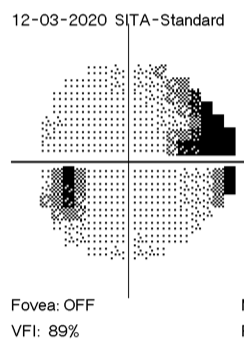
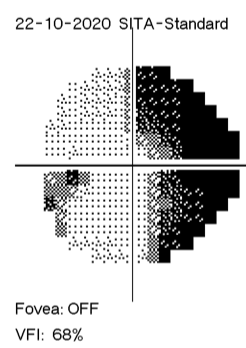
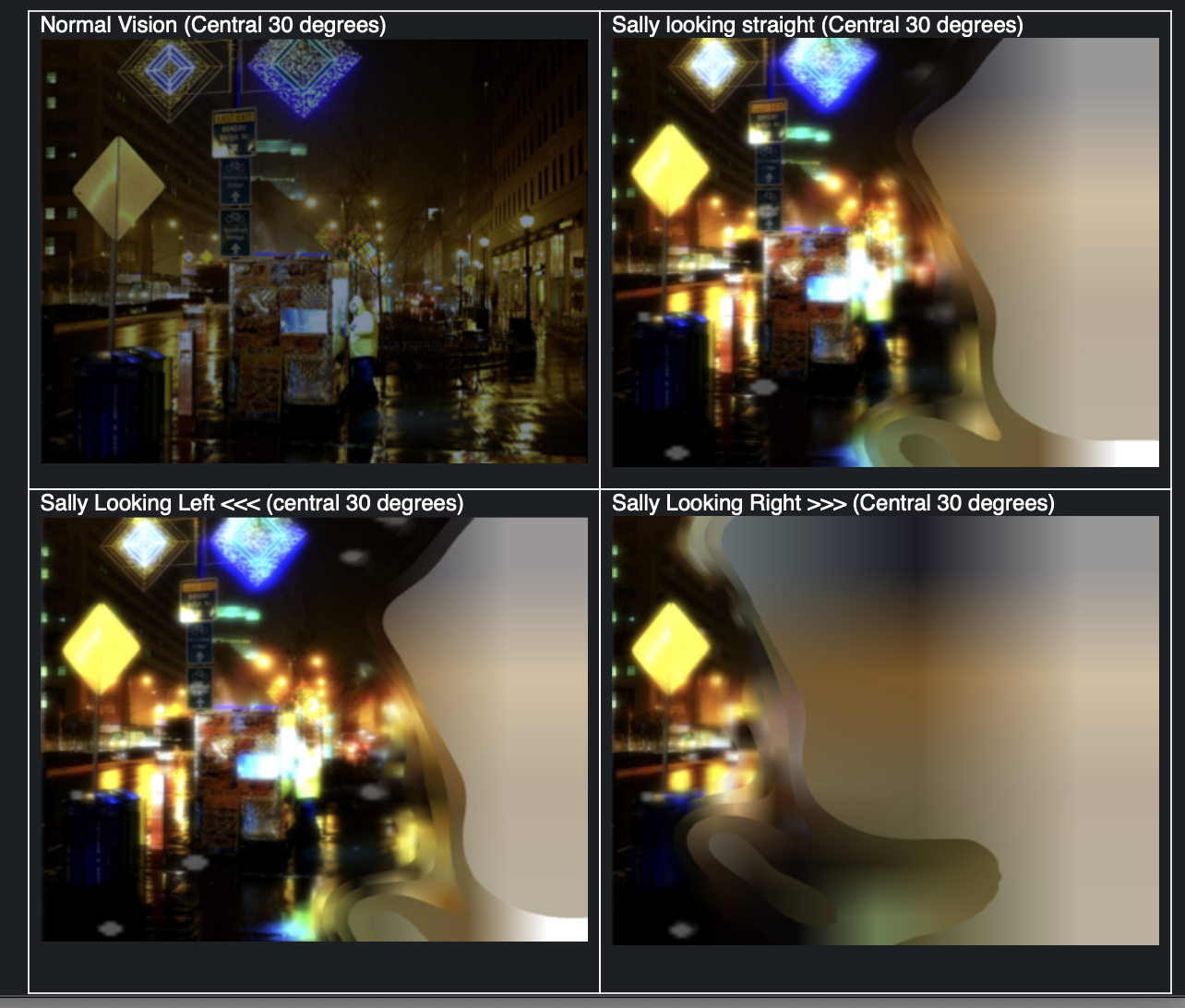
In trying to explain this to a friend, I searched for ways to simulate and found the following simulator. I typed in my information (visual acuity, mapped out my visual field test and added glare sensitivity and floaters to come up with the photograph below.
The photograph below is a simulation of what I see. Kudos to Dr Peter Jones at the University College London for his initial development of OpenSimVis with an online prototype that allows you to simulate visual field tests overlaying a photograph while adding glare and other symptoms.
The biggest realisation in all of the reflection is how much harder I need to work to see things than I used to, which all takes time, energy and brainpower. The new normal will include tripping over, taking longer to do some things and managing fatigue in a dynamic environment.
It also involves acknowledging that these things will impact every other aspect of my life, and it is how I view this and manage it that is the most important. I suspect taking the time to focus on this / myself will make all other aspects of my life – like my job more manageable.